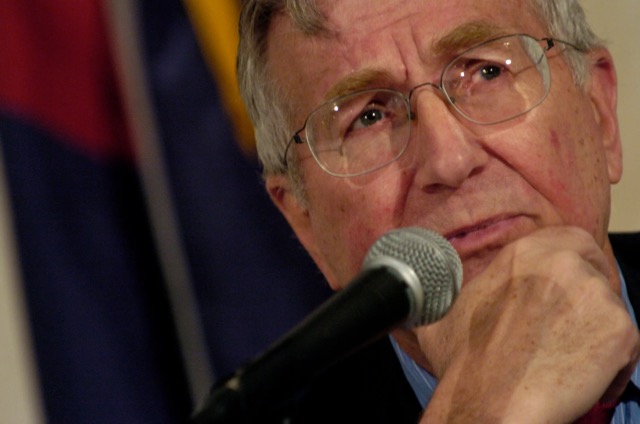
Investigative journalist Seymour (“Sy”) Hersh is a complicated man.
88 years old today, his career has been a testament to his courage, tenacity and outrage, believing America could only get better if the dark recesses that our government is always hell-bent on covering-up could be exposed to the light of his story-telling.
His half-century of revelations have extended from the massacre of over 500 villagers, including babies and pregnant women, in My Lai during the Vietnam War in 1968 (in order to contribute “body counts” that our military leaders at the time felt they needed for their press briefings), to the first person accounts and shattering cellphone images of Iraqis being tortured by American interrogators and their dogs at the secret Abu Ghraib prison in 2004.
Along the way, Hersh also revealed the illegal bombing of neutral Cambodia during the Vietnam War; how the Committee to Re-elect the President paid “hush money” to those on trial for the Watergate break-in; how the CIA, in violation of its charter, “conducted a massive, illegal domestic intelligence operation during the Nixon administration against the antiwar movement and other dissident groups in the United States”; and that same CIA’s illicit and ultimately unsuccessful attempts to breed their own Manchurian Candidate through the use of LSD.
He also got things wrong over the years. For example, he believed Syria’s Bashar al-Assad’s denials about using chemical weapons against his own people in 2013, saying (with more than a little defiance) in a recent interview:
I saw him two, or three, or four times, and I didn’t think he was capable of doing what he did, period. Is it an example of getting too close to power? Of course. What else is it? I never thought he was Mother Theresa, but I thought he was ok. If I have made the claim in prior interviews that I was perfect, I would now withdraw it.
And even more recently, in 2023, Hersh relied on a single source, who turned out to be unreliable, for his charge that the CIA had collaborated with Norway to blow up the North Stream pipeline that was providing Russian gas to Germany (“So what? So what? Legitimate criticism. Absolutely.”)
But, the cranky, defensive, indomitable, paranoid and often funny Hersh is still at it today, with a Substack that of course he calls “It’s Worse Than You Think.”
What I wanted to know is: Does Pulizer-Prize winning, muck-raking journalism like his really matter any more? And perhaps even more importantly: What drives someone to do it in the first place?
For example, we seem so much more resigned in our cynicism about our government today. In 1968, a so-called Silent Majority of Americans seemed to believe “the best” about our country, while only a fringe of young people, long-hairs and counter-culture reporters like Hersh were intent on decrying “the dark side.” These days, after 50+ years of exposés, our hearts barely flutter as the next outrage becomes normalized almost as soon as it is flagged.
The current administration also challenges this kind of “truth-telling” in a couple of novel ways.
It barrages the public with so many outrages that one’s focus on one of them is quickly eclipsed by its successor. It’s an attention-span issue surely, but also a bottomless pit. Even if another Hersh were able to connect-all-the-dots and establish culpability for one outrage, whoever’s tuned-in may feel hopeless & resigned instead of righteous & emboldened by the time he/she gets to the punchline.
Moreover, while all governments want to hide their dirty laundry, the current one almost succeeds in making that impulse into a kind of virtue. For example, many Americans seem convinced when our president publicly proclaims that it is somewhere between unpatriotic to traitorous to acknowledge our history of discrimination, our economic reliance on slavery until the Civil War, our dispossession of native Americans, and the like because “everybody” wants to be uplifted “by the best in our past.” Effectively making new disclosures about bad things disfavored as a matter of public policy is fairly unprecedented in American history, except during wartime.
The further application of this “patriotic outlook” has been to erect higher barriers of secrecy and to impose harsher punishments for unauthorized disclosures by government insiders during Trump 2.0. In some ways this is just the public enshrinement of a phenomenon that’s been a truth throughout the entire Hersh era, namely, that the only ones who usually end-up being held accountable in the course of an exposé are the confidential sources and whistle-blowers. Still, the public firings of inspectors general in nearly all governmental bodies & restricting the access for journalists in, say, the Pentagon, make the risks assumed for the sake of claiming an overwhelmed public’s awareness seem even more daunting these days.
So if that’s the case, what motivates Hersh and other investigative journalists to crawl around in our government’s most fetid basements to uncover “what’s really been going on” for the sake of a healthy democracy?
In Sy Hersh’s case, I sought the answer in a couple of recent profiles and in one long, hindsight look into his career.
A half a year ago, two other investigative journalists (Laura Poitras & Mark Obenhaus) released an engrossing & provocative documentary called “Cover Up” about Hersh’s remarkable career. Among other things, it was short-listed for this year’s Oscars. Here’s a link to its trailer on Netflix.
Poitras may be known to you as the award-winning journalist and filmmaker behind “Citizenfour” (about Edward Snowden’s exposure of the government’s mass surveillance) as well as “All the Beauty and the Bloodshed” (about Nan Goldin’s activism during the AID’s epidemic and her fight to expose the Sackler family’s complicity in the opioid crisis) which she co-directed with Obenhaus. In addition, I caught Poitras’s On the Media interview this week, and Obenhaus’s interview in the Times in February, both about Sy Hersh and his groundbreaking work.
Meanwhile, another attempt to sum-up Hersh’s investigative accomplishments and occasional failures was provided in 2018 by Matthew Ricketson in an Inside Story essay.
From these viewpoints and some leaping-to-my-own-conclusions, I’ll try to resolve what makes someone like Hersh do what he does, and why such work matters today as much—if not more—than ever.
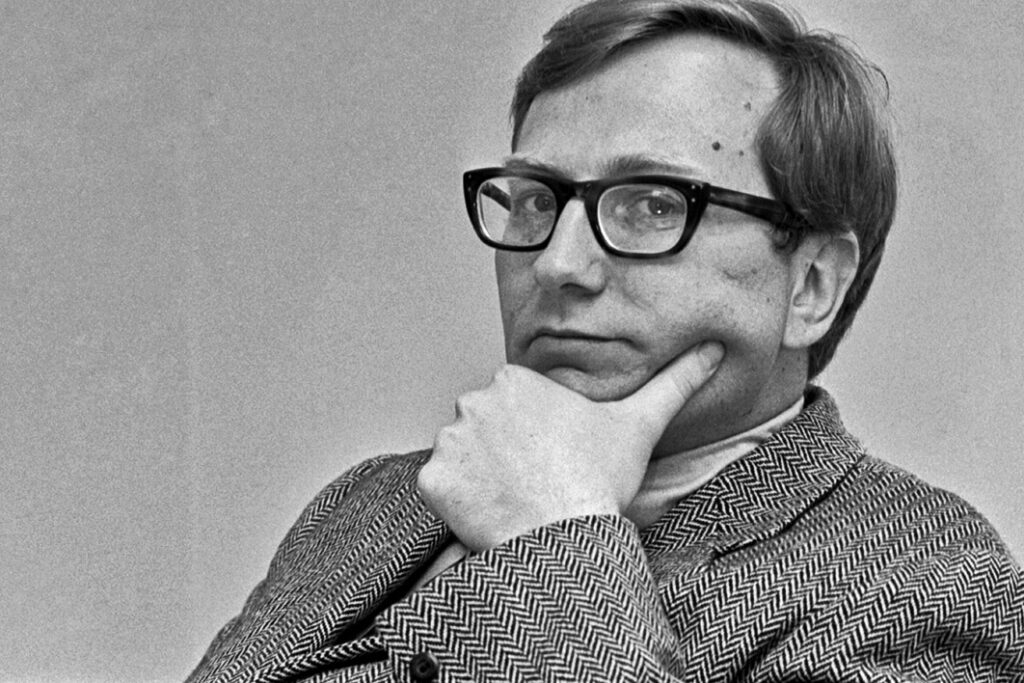
This is the young Sy Hersh after he won a Pulitzer Prize for his book “MyLai 4: A Report on the Massacre and its Aftermath.
“For-the-sake-of-democracy” arguments are the ones repeated most often to extoll the virtues of investigative journalism in this country. Of course, such arguments require enough citizens who are: paying attention to that reporting, able to reach a judgment about what they’ve learned, and willing to do something about it if it violates their norms, including voting against it or otherwise registering their dissent.
Even though by some counts there may be fewer such engaged citizens today, it seems fair to conclude that whatever else was accomplished by last weekend’s No Kings rallies, at least the 8 million Americans who took to the streets are probably ringing those engagement bells today.
Hersh, of course, has always stood squarely with those who dare “to speak truth to power,” in that sadly over-used phrase. For her part, Laura Poitras doesn’t see government secrecy, abuses of power, and vindictiveness towards sources as much different today than they have always been. Nor are investigative journalists less fearless today. Instead, she describes one perennial problem that separates the more institutional media from what she views as the far more impactful muckrakers like Hersh, along with a worrisome shift in who controls the mass media itself today as opposed to in the 1960s.
The shortcoming in her view is that too many of today’s journalists fail to describe what their reporting uncovers in a clear and honest way, leaving the far-too-common impression that they are merely government mouthpieces. For instance, if it’s torture, don’t call it “enhanced interrogation techniques” as if there were some kind of science involved. She also decries the coverage of Gaza when reporters try to make the situation palatable to everyone.
What we’re seeing in Gaza, how can we look at a population that’s being starved and civilians being bombed for two years and not call it a genocide? I just think we have to use the words that we know to describe what is happening. The erosion of trust in the media is because the public often feels lied to. They feel lied to by their government, and they feel that the press is also part of the lying.
She’s also more worried about corporate developments affecting today’s journalism than any shortage of investigative reporters today.
Currently, I’m very concerned about the capitulation of large media organizations to government pressure. Both the settlement around 60 Minutes, and Paramount and ABC not fighting for the First Amendment, I think, is the biggest threat we’re seeing. That’s coming from institutions, not from journalists doing their jobs.
But Sy Hersh never fit comfortably within corporate media, famously leaving the New York Times after his own coverage of preferential loans being received by an American business conglomerate during the 1980’s bumped up against the reality of similar loans being accepted by members of Times’ management. As a result, for the entirety of his career, Hersh has regularly gone outside & around the System for his “truths” instead of through it.
For example, rejecting the pre-packaged sound bites his colleagues were receiving in the Pentagon briefing room during Vietnam, Hersh would listen for the idle remark in casual conversations with insiders far outside of it, finding the scent of the My Lai massacre when he heard one source say: “Well, it’s murder incorporated over there,” and then wondering like a bloodhound what was behind that tossed-off comment.
But his cultivation of sources and careful listening were only the start of it. One reviewer of the “Cover-Up” documentary commented on both “the obsessiveness” and “the painstakingness” (or doggedness & discipline to do the necessary digging) that makes an investigative journalist like Hersh “in the behavioral sense.” At the same time, another reviewer was surprised by how reluctant Hersh has always been to put himself into his stories
Restless, kinetic, energized by the word no, he’s quick to recite the facts and loath to put himself in the story. ‘In case anyone cares, this is less and less fun,’ he says [around the mid-point of “Cover-Up”] in what appears to be two sit-down interviews at his home office, surrounded by mountains of faded yellow legal pads.
Perhaps it’s the reluctance to become any kind of celebrity in his own right that most distinguishes him from the other “most famous” investigative journalist of his age—Bob Woodward. After all it was Woodward & his pal Bernstein who not only broke the first Watergate story but who were also portrayed in “All the President’s Men” by no less than Robert Redford and Dustin Hoffman. Ricketson’s Inside Story profile is particularly insightful about what distinguishes the two reporters.
[I]n Donald Trump’s America, there is a strong argument that what is needed is more Hershes and fewer Woodwards….
[A] comparison of their reporting] shows Hersh hewing more closely to the promise of public interest journalism. ‘Bob has become the diarist of sitting administrations,’ says Bill Kovach, a former editor at the New York Times, ‘and Sy has continued to be the muckraker. Sy continues his outrage.’
Or, as Mark Danner, himself a respected American investigative journalist, puts it: where Woodward relies for his disclosures on officials at the highest level of government, Hersh’s sources come from lower levels of the government and intelligence bureaucracy. ‘Where Woodward provides the deeper version of what is, essentially, the official story, Hersh uncovers a version of events that the government does not want public — which is to say, a version that contradicts the official story of what went on.’
In other words, Hersh was never an insider, playing an outside-the-system role that his targets, like Henry Kissinger and Richard Perle (himself a powerful business figure connected to the first Bush administration), ‘feared and intensely disliked,’ while Woodward’s more affable demeanor and institutional touch produced more best-selling books and fueled more frequent appearances on talk-shows. For his part, Perle once summed up their differences even more succinctly, arguing that “Sy Hersh is the closest thing American journalism has to a terrorist.”
So while one always needs to proceed with caution when using autobiographical details to explain career motivations, I found it particularly revealing that Sy Hersh never learned about his father Isadore’s searing legacy until long after he had died, and then went on to render a surprisingly harsh judgment about that silence in his 2018 memoir.
In 1941, the entire Jewish population of his father’s birthplace, the village of Seduva in Lithuania, was executed by a German commando unit aided by Lithuanian collaborators. His father had never discussed the atrocity with him in a childhood that was filled with fatherly interactions. Of this omission, Hersh’s judgment is both brutal & telling: “In his own way, Isadore Hersh was a Holocaust survivor as well as a Holocaust denier.”
It’s another way of saying “The truth can set you free” I suppose, and there are few pursuits beyond safety & sustenance that are more powerful than that.
These days we hear ad nauseam that Americans are more concerned about the cost-of-living than any of the crimes & other outrages of our current government.
Moreover, the Supreme Court’s recent decision in Trump vs. U.S. to grant the president immunity for all of his “official acts” puts the onus on identifying, exposing and prosecuting all of his “unofficial” ones. Moreover, many have argued that Trump’s opponents would be better off “holding their powder” while trying instead to identify fresh leaders with compelling proposals to address affordability and other pressing issues like clean energy & AI’s growing impact on the American workforce.
But should investigative journalists like Hersh similarly “hold their powder,” and what kind of exposé would make a genuine difference for the health of America’s democracy today?
To these questions, I can only answer that Hersh’s coverage of the My Lai massacre was critical in turning the American public against the War in Vietnam, while his coverage of torture at the Abu Ghraib prison similarly helped to turn pubic horror into public opposition to our War in Iraq.
One man’s investigative journalism.
Think about how Hersh’s truth-telling—or a similar dose of truth from someone like him—might help to set us all free today.
This post was adapted from my April 5, 2026 newsletter. Newsletters are delivered to subscribers’ in-boxes every Sunday morning, and sometimes I post the content from one of them here, in lightly edited form. You can subscribe by leaving your email address in the column to the right.


Leave a Reply