David Griesing | Work Life Reward Author | Philadelphia

  • Blog
  • About
    • Biography
    • Teaching and Training
  • Book
    • WorkLifeReward
  • Newsletter Archive
  • Contact
You are here: Home / Archives for David Griesing

Will Our Comics Get the Last Laugh?

September 23, 2025 By David Griesing Leave a Comment

The killing of Charlie Kirk—the MAGA Right’s golden boy & recruitment engine—continues to reverberate on the citizen-side of my brain.

It’s first echo was the sidelining of comic Jimmy Kimmel, but we probably share the worry that the next repercussion will be a death for a death. Kirk wouldn’t have wanted that, but it seems that there are too many disaffected boys waiting in their basements to be “called-into-action” for it to be otherwise.

I tried to react to Kirk’s murder in the ways that I needed to in last week’s We’ve Entered the Arsonist’s Age but I didn’t go far enough in capturing what Kirk embodied or in describing the brakes on political violence that exist today. It feels necessary to do both before more dominoes start to fall. 

So that’s where I’ll begin this morning, before getting to comedy’s ability to mobilize an opposition and inhibit those with Strongman tendencies.

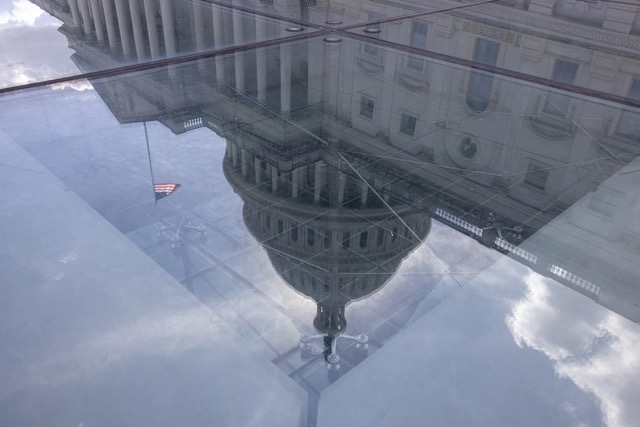
Hanging over all of these themes is a sense of foreboding and menace, like in the photo above by Dane Manary. While part of America may still be at the beach, even more of the President’s warriors have started to engage.

+ + +

As with most consequential politicians, Charlie Kirk’s outreach defied easy judgment. His cheerfully engaging young people in conversation was admirably effective. Still, he dominated nearly every exchange with talking points he’d honed hundreds if not thousands of times before while his interlocutors often sounded like they were defending their views for the very first time. The Charlie Kirk show was often more respectful than cruel in part because those who’d brought him their questions would often make fools of themselves long before he fully engaged them. Nevertheless, his patience, resolve and “willingness to put himself out there time and time again” could be a marvel to behold. 

Less marvelous were Kirk’s “enemy lists” of woke professors (some who had done no more than proclaim their solidarity with Palestinian suffering or complained about concealed weapons laws on campus). They operated as rallying cries to his more ardent followers to harass and intimidate these academics, sometimes causing personal damage that far exceeded the parameters of any fair debate. Moreover, his tarring of whole groups also seemed more injurious than necessary to make his points about, say, immigrants, abortion or Black Lives Matter. 

I also want to say a bit more about “hate speech” in general, and incitement to violence in particular. 

Under the First Amendment, even the most hateful speech—like some of the words that danced on Kirk’s grave last week—are protected, because in and of themselves, they do not constitute violence however badly they make some listeners feel.  Decades of Supreme Court decisions say so, and whatever your view of the Court today, they are likely to stand.

Among other things, that means it’s likely illegal for employers to fire employees who took to their private social media accounts to say hateful things about Charlie Kirk (because Kirk’s supporters discovered where they worked and “doxed them” to their employers). Still, it can be a somewhat hollow victory because fired employees, like those “woke” professors before them, usually suffer their harms long before their First Amendment rights can be vindicated.

In other words, just because you have a right doesn’t mean it protects you in a timely manner. You may need to fight for many expensive years before some tribunal finds that its protection “applies to you”—a time lag and personal burden that menaces our current politics. That’s because: if a big enough minority of Americans and our most powerful leaders wish to exploit these realities, Constitutionally-guraranteed free speech will increasingly be “chilled” by threats causing harms long before the necessary debates can occur.

Moreover, when Kirk invited students to target their “woke” professors or Trump invited his angriest supporters to seek his preferred justice at the Capitol on January 6, 2021, it’s been argued that they were illegally inciting their foot-soldiers to violence.  So what would it take for that charge to stick?

Last week, when I quoted Trump’s calling for “all of those” who were “responsible” for Kirk’s murder to be held accountable, he could only be found guilty of incitement if a court could infer “the intent to harm others” from his words, and some unhinged follower actually heeded his call and exacted some violent retribution in response. 

The leading Supreme Court case here is Brandenburg v. Ohio, 395 U.S. 44 (1969), and we all need to become more familiar with its two-part standard for liability given the confusing political noise around it today. For speech to constitute “incitement,” Brandenburg requires it to be (1) directed at inciting or producing imminent lawless action and (2) likely to incite or produce such action. That means “inciting speech” loses First Amendment protection when the speaker intends to cause immediate violence and is, under the circumstances, likely to succeed in provoking it.

From where I sit as a lawyer, Trump’s speech to a mob of angry supporters he had called to Washington on January 6th met the legal definition of incitement to violence and should have been, but never was punished. Since he effectively “got away with it once,” he and his least temperate proxies are continuing to poke the tinderbox of Right-wing incitement to every grievance he expresses—because that’s the end of the political spectrum in America that’s bred the most violence in recent memory according to a study by the Cato Institute, a respected libertarian think tank. 

Which brings us to the fate of political comedy these days.

Nothing bites “the man who would be king” like ridicule. Luckily, some of our democratic institutions (like stand-up comedy) are still alive and kicking–at least for now.

Comedian, and Jimmy Kimmel’s fellow talk show host, Stephen Colbert gave what was likely the most effective comic response to Kimmel’s suspension from ABC in a brilliantly modified version of the “Be Our Guest” song and dance number from Disney’s “Beauty & the Beast” a few days ago. Not only did it skewer Trump’s vanity and vindictiveness, it also effectively pilloried Disney (as ABC’s owner) and its boss Bob Iger for allowing Kimmel’s censorship.

In addition, Trump undoubtedly noticed how some British “comedians” heralded his visit to the royals this week by projecting images of him with Jeffrey Epstein onto the walls of Windsor Palace while he was about to be indulged there. 

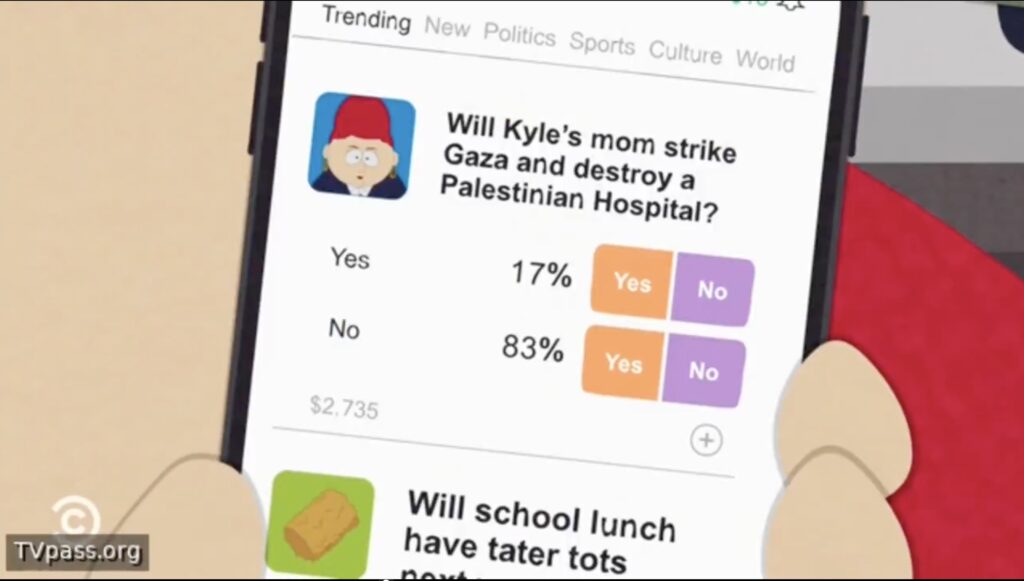
On the other hand, South Park’s “postponement” of the episode that was expected to run this week seemed more ominous. Even Colbert’s parody failed to bite as deeply into Trump’s image of himself as Trey Parker and Matt Stone have been managing, but the South Park franchise is also owned by a media conglomerate that’s run by the son of Trump buddy Larry Ellison, so some feared interference.

While South Park said they’d “run out of time” to wrap the episode, and it’s been reported that the guys wanted “to find the right tone and approach to addressing current events,” it was hard to escape the specter of more censorship, particularly in light of the show’s most recent storyline about Trump’s amorous relationship with Satan. It should also be noted that South Park parodied Charlie Kirk in an August episode (“Clyde Donovan destroys woke liberal students” etc.), though Kirk himself (almost alone among his post-mortem defenders) admirably said that he found his portrayal in the parody to be both “awesome” & “hilarious.” 

Perhaps the last word this week about comedy’s impact on would-be authoritarians came from one of the guests on this week’s Colbert show,  New Yorker editor David Remnick. Before leading the magazine, Remnick had been a reporter in the Soviet Union in the years when it was transitioning from Gorbachev’s glasnost to Putin’s rise. Tellingly, Remnick reminded us that Putin’s very first act upon becoming Russia’s new leader was to censor one of the country’s leading parodies, and eventually the entire network that had run this troublesome puppet show. Here’s a clip of Remnick’s timely comments. 

Among other things, this parallel between Putin and Trump 2.0 also is a reminder that it’s not just the comedian but also the broadcasting network (or conglomerate with its billionaire investors) that also play a key role in crackdowns on political comedy, especially when it’s hitting its marks most effectively. 

It was the possibility of reprisal by Trump’s Federal Trade Commission (FCC) that cowed Disney/ABC and is local affiliate conglomerates (Nextar and Sinclair) to pull Jimmy Kimmel off the air despite the non-existent First Amendment grounds for doing so. All of these companies have upcoming mergers that need FCC approval, and both Nextar and Sinclair need FCC authorization to buy more than the currently mandated maximum of affiliate television stations so they don’t “unfairly dominate” their particular markets. By kowtowing to Trump’s wishes in July (“Kimmel should be the next to go”), all three corportations hope to curry favor with the FCC and get any “problems” waived.

Moreover, media conglomerates and their billionaire investors will continue to play an outsized role in the censorship of comics in particular as well as in the reporting of “the news” more generally. Because while his ultimate aims may never be realized, the aforementioned Larry Ellison—who already is a major stakeholder (through his son) in CBS/Paramount, the company that recently cancelled Colbert’s contract for another year—is also looking to acquire CNN, HBO and a major stake in TikTok. As an essayist in the Times noted on Thursday: 

If all goes as anticipated, this tech billionaire, already one of the richest men in the world and a founder of Oracle, is poised, at 81, to become one of the most powerful media and entertainment moguls America has ever seen….

Along with his son, David, he could soon end up controlling a powerful social media platform, an iconic Hollywood movie studio and one of the largest content streaming services, as well as two of the country’s largest news organizations. Given Mr. Ellison’s friendship with, and affinity for, Donald Trump, an increasingly emboldened president could be getting an extraordinarily powerful media ally — in other words, the very last thing our country needs right now.

Once again, Ellison’s ambitions may never be realized, but the trend lines are clear. Almost all of our channels of information are controlled by billionaires who seem eager to do Trump’s bidding, either because they share his grievances or are willing to do whatever’s required to secure government backing for their business objectives. This also goes for Elon Musk and Twitter/X, Mark Zuckerberg and Facebook/ Instagram, and Jeff Bezos with the Washington Post. Of these, Musk seems most aligned with Trump’s desire to crack down on speech that’s critical of his governance, though all have enormous incentives “to go along to get along” because they (along with their investors) want profits instead of battles over the First Amendment.

So will our American comics have the last laugh?

If we follow the Putin analogy, the only places where you can find Russian comics (or a free press) these days are in places like the Baltic states and the Netherlands. And whether you call them oligarchs or billionaires, both Putin and Trump prefer to surround themselves with men who manage large segments of their respective economies in the ways that they want them to be managed.

For America, that means getting the information (including the comedy) we both want and need may increasingly depend on whether folks like the Ellisons believe in a free press and appreciate the liberating qualities of political humor. 

This post was adapted from my September 21, 2025 newsletter. Newsletters are delivered to subscribers’ in-boxes every Sunday morning, and sometimes I post the content from one of them here, in lightly edited form. You can subscribe by leaving your email address in the column to the right.

Filed Under: *All Posts Tagged With: billionaires, Brandenburg v Ohio, censorship, Charlie Kirk, Colbert, Comics, David Remnick, Disney, First Amendment, hate speech, hate speech is not violence, incitement to violence, incitement to violence legal standard, Kimmel, Larry Ellison, media conglomerates, oligarchs, Parody, Political comedy, Putin, South Park

Using AI to Help Produce Independent, Creative & Resilient Adults in the Classroom

September 10, 2025 By David Griesing Leave a Comment

I learned something that made me smile this week. 

An innovator at the leading edge of American education and technology (or “ed-tech”) named Steve Hargadon picked up on a thesis I’d advanced some time ago in “The Amish Test & Tame New Technologies Before Adopting Them & We Can Learn How to Safeguard What’s Important to Us Too” and applied it to the use of AI in our classrooms today.

For both better and worse, we’ve let marketers like Google (in search), Facebook (in social media), and Apple (in smart phones) decide how we integrate their products into our lives—usually by dropping them on top of us and letting each new user “figure it out.”

But instead of being left with the hidden costs to our privacy, attention and mental health, we could decide how to maximize their benefits and limit their likely harms before we get hooked on these products, the types of assessments that groups like the Amish always undertake —as another innovator in this space (Wired co-founder Kevin Kelly) noted several years ago.

To further the discussion about our use of technology generally and ed-tech in particular, I’ll briefly review the conclusions in my Test & Tame post and summarize a more recent one (“Will AI Make Us Think Less or Think Better”), before considering Hargadon’s spot-on proposals in “Intentional Education with AI: The Amish Test and Generative Teaching.”

The traditional Pennsylvania Amish work their farms and small businesses at a surprisingly short distance from Philadelphia. When I venture out of town for an outing it’s often to Lancaster County, where the car I’m in is quickly cheek-to-jowl with a horse and buggy, and families hang their freshly washed clothes on lines extending from back doors instead of cramming them into drying machines. It’s hard to miss their strikingly different take on the “modern conveniences” that benefit as well as burden the rest of us. What Kelly and others pointed out was that the Amish manage their use of marvels like cars or dryers as a community, instead of as individuals.

I described the difference this way:

As consumers, we feel entitled to make decisions about tech adoption on our own, not wishing to be told by anybody that ‘we can buy this but can’t buy that,’ let alone by authorities in our communities who are supposedly keeping ‘what’s good for us’ in mind. Not only do we reject a gatekeeper between us and our ‘Buy’ buttons, there is also no Consumer Reports that assesses the potential harms of [new] technologies to our autonomy as decision-makers, our privacy as individuals, or our democratic way of life — no resource that warns us ‘to hold off’ until we can weigh the long-term risks against the short-term rewards. As a result, we defend our unfettered freedom until we start discovering just how terrible our freedom can be.

By contrast, the Amish hold elaborate “courtship rituals” with a new technology before deciding to embrace some or all of its features—for example sharing use of the internet in a device that all can access when its needed INSTEAD OF owning your personal access via a smart phone you keep in your pocket. They reach a consensus like this from extensive testing of smart phone use & social media access within their community, appreciating over time its risks in terms of “paying attention” generally, or “self-esteem among the young” more particularly, before a gatekeeper (like a bishop) decides what, if any, accommodation with these innovations seems “good” for all.

The community’s most important values are key to arriving at this “testing & taming” consensus. The Amish openly question whether the next innovation will strengthen family and community bonds or cause users to abandon them. They wonder about things as “small & local” as whether a new technology will enable them to continue to have every meal of the day with their families, which is important to them. And they ask whether a phone or social media platform will increase or decrease the quality of family time together, perhaps their highest priority. The Amish make tech use conform to their values, or they take a pass on its use altogether. As a result,  

the Amish are never going to wake up one day and discover that a generation of their teenagers has become addicted to video games; that smartphones have reduced everyone’s attention span to the next externally-generated prompt; or that surveillance capitalism has ‘suddenly’ reduced their ability to make decisions for themselves as citizens, shoppers, parents or young people.

When I considered Artificial Intelligence’s impacts on learning last month, I didn’t filter the pros & cons through any community’s moral lens, as in: what would most Americans say is good for their child to learn and how does AI advance or frustrate those priorities? Instead, I merely juxtaposed one of the primary concerns about AI-driven chatbots in the classroom with one of their most promising up-sides. On the one hand, when an AI tool like ChatGPT effectively replaces a kid’s thinking with its own, that kid’s ability to process information and think critically quickly begins to atrophy. On the other hand, when resource-rich AI tutors are tailored to students’ particular learning styles, we’re discovering that these students “learned more than twice as much as when they engaged with the same content during [a] lecture…with personalized pacing being a key driver of success.”

We’re also realizing that giving students greater control over their learning experience through “personalized on-demand design” has:

allowed them to ask as many questions as they wished and address their personal points of confusion in a short period of time. Self-pacing meant that students could spend more time on concepts they found challenging and move quickly through material they understood, leading to more efficient learning….

Early experience with Ai-tutors has also changed the teacher’s role in the classroom. While individualized tutoring by chat-bots will liberate teachers to spend more time motivating students and being supportive when frustrations arise, 

our educators will also need to supervise, tweak and even design new tutorials. Like the algorithms that adapt while absorbing new data, they will need to continuously modify their interventions to meet the need of their students and maximize the educational benefits.

Admittedly, whether America’s teachers can evolve into supervisors and coaches of AI-driven learning in their classrooms—to in some ways, become “even smarter than [these] machines”— is a question “that will only be answered over time.”

Meanwhile, Steve Hargadon asks an even more fundamental question in his recent essay. Like the Amish, he wonders:

What is our most important priority for American students today, and how can these new, AI capabilities help us to produce the adutls that we want and that an evolving American community demands?

In what I call his “foggy window paintings,” photographer Jochen Muhlenbrink
finds the clarity through the condensation (here and above). I borrowed his inspiration
in a photo that I took of our back door one night a few years back (below).

Hargadon begins by acknowledging a lack of consensus in the American educational community, which startled me initially but which I (sadly) came to realize is all-too-true.

Unlike most Amish communities, American education is “a community of educators, students and stake-holders” in only the loosest sense. It’s also an old community, set in its ways, particularly when it comes to public education (or “the educating” that our tax dollars pay for). Writes Hargadon:

Here’s an uncomfortable truth: traditional schooling, despite promises of liberating young minds, has always excelled more at training compliance than fostering independent thinking. While we often claim otherwise, it’s largely designed to create standardized workers, not creative thinkers.

Unless we acknowledge this reality, we’ll miss what’s really at stake with AI adoption. Unexamined AI use in an unexamined education system will amplify these existing flaws, producing students who are even less self-directed and capable. The temptation for quick AI-generated answers, rather than wrestling with complex problems, threatens the very traits we want in our future adults: curiosity, agency, and resilience. (emphasis added)

If we examine the American education system and consider it as a kind of community, it quickly becomes apparent that it’s a much more diverse and divided in terms of its priorities than the Amish.

Moreover, because non-Amish Americans often seem to love their individual freedoms (including choosing “what’s good” for their children), more than the commitments they share (or what’s best for all), the American educational community has often seemed reluctant, if not resistant, to accepting the guidance or governance of a gate-keeper in their classrooms.

So while some of us prefer tech-tools that get students to the right answers (or at least the answers we’ll test for later), others prefer fostering a vigorous thinking process wherever it might lead. 

Hargadon, along with me and the AI-tutor developers I wrote about in July clearly prefer what he calls “generative teaching,” or building the curious and resilient free-agents that we want our future adults to be. So let’s assume that we can gather the necessary consensus around this approach—if not for the flourishing of our children generally, but because an increasingly automated job market demands curiosity, resilience and agency for the jobs that will remain. Then “the Amish test” can be put into practice when evaluating AI-tools in the classroom.

Instead of asking: Will this make teaching easier [for the teachers]?
Ask: Will this help students become more creative, self-directed, and capable of independent thought?

Instead of asking: Does this improve test scores?
Ask: Does this foster the character traits and thinking skills our students will need as adults?

With their priorities clear, parents and students (along with American education’s many other stakeholders) would now have a “test” or “standard” with which to judge AI-driven technologies. Do they further what we value most, or divert us from a goal that we finally share?

To this dynamic, Hargadon adds a critical insight. While I mentioned the evolving role of today’s teachers in the use of these tools, he proposes “teaching the framework” to students as well. 

Help students apply their own Amish Test to AI tools. This metacognitive skill—thinking about how they think and learn—may be more valuable than any specific technology…

[By doing so,] students learn to direct technology rather than be directed by it. They develop the discernment to ask: ‘How can I use this tool to become a better thinker, not just get faster answers?

When this aptitude finally becomes engrained in our nation’s classrooms, it may (at last) enable Americans to decide what is most important to us as a country—the commitments that bind us to one another, and not just the freedoms that we share—so we can finally start testing & taming our next transformational technology on how it might unify the American people instead of divide us.

For the past 4 months, I’ve been reporting on the state of American democracy’s checks & balances because nothing should be more important to our work as citizens than the continuing resilience of our democratic institutions. And while I assumed there might be some “wind-down” in executive orders and other actions by the Trump White House in the last few weeks of August, the onslaught in areas big & small continued to challenge our ability to respond to each of them in any kind of thoughtful way.

Other than mentioning this week’s bombing of an unidentified vessel in the the Gulf of Mexico; threat of troops to Chicago, Baltimore and New Orleans; turmoil at the Centers for Disease Control; immigration raid on a massive EV plant in Georgia; more urging that Gaza should be turned into the next Riviera; the president’s design of a new White House ballroom; and Vladimir Putin’s repudiation of America’s most recent deadline on Ukraine, Trump’s leadership today faces 2 crossroads that may be even more worthy of your consideration.

At the Department of Labor in Washington D.C. this week

1.    What we’re seeing & hearing is either a fantasy or a preview.

In a subscriber newsletter from the New York Times this week, columnist Jamelle Bouie writes:

The administration-produced imagery in Washington is… a projection of sorts — a representation of what the president wants reality to be, drawn from its idea of what authoritarianism looks like. The banners and the troops — not to mention the strangely sycophantic cabinet meetings and news conferences — are a secondhand reproduction of the strongman aesthetic of other strongman states. It is as if the administration is building a simulacrum of authoritarianism, albeit one meant to bring the real thing into being. No, the United States is not a totalitarian state led by a sovereign Donald Trump — a continental Trump Organization backed by the world’s largest nuclear arsenal — but his favored imagery reflects his desire to live in this fantasy.

The spectacle that falsifies reality is nevertheless a real product of that reality, while lived reality is materially invaded by the contemplation of the spectacle and ends up absorbing it and aligning itself with it,’ the French social theorist Guy Debord wrote in his 1967 treatise ‘The Society of the Spectacle,’ a work that feels especially relevant in an age in which mass politics is as much a contest to construct meaning as it is to decide the distribution of material goods.

2.    Trump seems to be dealing with everything but “pocketbook issues”—or (in James Carville’s famous words during the 1992 presidential election), “It’s the economy, stupid.”

This week, the Wall Street Journal reported that after trending up in June and July, consumer sentiment dropped nearly 6% in August according to the University of Michigan’s “closely watched” economic sentiment survey. “More U.S. consumers now say they’re dialing down spending than when inflation spiked in 2022,” the article says. “Over 70% of people surveyed from May to July plan to tighten their budgets for items with large price increases in the year ahead….”

In a rejoinder, columnist Karl Rove mentioned a new WSJ/National Opinion Research Center poll that shows “voters are sour about their circumstances and pessimistic about the future.” As we head into the fall and towards the mid-terms next year, Rove opines: “It’ll take a lot more than happy talk” to counter these impressions. “People must see positive results when they shop, fuel up their cars, deposit paychecks and glance at their retirement accounts.”

As of this week, there is no sign that any plan for economic stability or growth is on the horizon, forecasting even more contentious, unsettling & expensive times ahead.

This post was adapted from my September 7, 2025 newsletter. Newsletters are delivered to subscribers’ in-boxes every Sunday morning, and sometimes I post the content from one of them here, in lightly edited form. You can subscribe by leaving your email address in the column to the right.

Filed Under: *All Posts Tagged With: Ai, AI-tutor, Amish, Amish Test & Tame New Technologies, artificial intelligence, chatbots, ChatGPT, Kevin Kelly, Steve Hargadon

Will AI Make Us Think Less or Think Better?

July 26, 2025 By David Griesing 2 Comments

Holding two opposing thoughts in your mind at the same time is to experience “cognitive dissonance.” 

Being of two minds about your beliefs, ideas or values can be stressful and some find it difficult to live with the uncertainty. However, others have argued that remaining curious and wanting to learn more about what’s behind a dissonance of thoughts is a positive sign—if you’re to believe these much quoted words from F. Scott Fitzgerald.  

The test of a first-rate intelligence is the ability to hold two opposed ideas in the mind at the same time and still retain the ability to function.

While I was stewing under the heat dome last week, I was struck by the extent of my cognitive dissonance about my soon-to-come, AI-driven world. I’m stressed about the imminence of devices that will put as many external brains as I can accommodate into the palm of my hand in about a year and a half. 

As you know, I’ve expressed my awe as well as trepidation about this development several times before. 

It’s cognitive dissonance for me (Luddite vs. Brave Pioneer) because of the consequences involved, because I fully agree with the observer who noted this week:  “we’re not just building new tech, we’re rethinking the role of humans in systems.”  Let me repeat that.

We’re not just building new tech, we’re rethinking the role of humans in systems.

One of the uncertain frontiers for AI-driven tools like ChatGPT is in our schools, those learning environments where student brains are still developing. An essay this week and a recent study make a strong (early) case for the disaster we might expect. When students use a tool like ChatGPT to write their papers and respond to class assignments, their critical-thinking and argument-assembly skills either never develop at all or quickly begin to atrophy.

At some point in the arc of my education and yours, pocket calculators became ubiquitous. I already knew how to add, subtract, multiply and divide, but no longer needed to do so manually. By the time that happened, my basic calculation skills were so brain-embedded that I could still do all of those things without my short-cut device. But what was it like for those who never embedded those aptitudes in the first place?

Given the sudden availability of AI-driven personal assistants, are today’s students at risk of never embedding or retaining how to think through, express and defend their ideas? How to construct arguments and anticipate rebuttals? How to find their commitments and form an opinion?  Such devices could change their’s (and our) experience of being human.

A Wall Street Journal op-ed on Tuesday by Allysia Finley brings a fine point to these questions. She argues that in the brave new world where “smart computers” demand even smarter humans, tools like ChatGPT are effectively “dumbing us down” by enabling “cognitive offloading”—or allowing a readily available device to do our thinking for us. The risk (of course) is that we’ll end up with too many humans who can’t keep up with—let alone control—the increasingly intelligent computers that are just over the horizon. 

The real danger is that excessive reliance on AI could spawn a generation of brainless young people unequipped for the jobs of the future because they have never learned to think creatively or critically…[However] workers will need to be able to use AI and, more important, they will need to come up with novel ideas about how to deploy it to solve problems. They will need to develop AI models, then probe and understand their limitations.

(I don’t know which dystopia fills Finley’s imagination, but in mine I’m seeing the helpless/mindless lounge-potato humans in the Pixar classic Wall-E instead of Arnold struggling to confront Skynet in The Terminator.)

A student brain continues to develop until he or she is in their mid-20s, “but like a muscle it needs to be exercised, stimulated and challenged to grow stronger.” Chatbots “can stunt this development by doing the mental work that builds the brain’s version of a computer cloud….”

Why commit information to memory when ChatGPT can provide answers at your fingertips? For one thing, the brain can’t draw connections between ideas that aren’t there. Nothing comes from nothing. Creativity also doesn’t happen unless the brain is engaged. Scientists have found that ‘Aha!’ moments occur spontaneously with a sudden burst of high-frequency electrical activity when the brain connects seemingly unrelated concepts.

With AI-driven devices in the palms of our hands, Finley worries that humanity will have fewer of those experiences going forward.

This week, Time Magazine reported on a new study from MIT’s Media Lab whose results so alarmed its lead investigator that she published its results despite the relatively small sample-size in her study and its lack of peer review. 

The study divided 54 subjects—18 to 39 year-olds from the Boston area—into three groups, and asked them to write several SAT essays using OpenAI’s ChatGPT, Google’s search engine, and nothing at all, respectively. Researchers used an EEG to record the writers’ brain activity across 32 regions, and found that of the three groups, ChatGPT users had the lowest brain engagement and ‘consistently underperformed at neural, linguistic, and behavioral levels.’ Over the course of several months, ChatGPT users got lazier with each subsequent essay, often resorting to copy-and-paste by the end of the study.” [emphasis mine]

The researchers also suggested that the use of AI-driven tools which rely on LLMs (or large language models) can harm learning, especially for users whose brains are still developing—because ”your brain does need to develop in a more analog way.”

Both the Op-ed and MIT study examined the use of ChatGPT without either supervision or guidance from those who know how to use these tools to enhance instead of merely “off-load” the learning experience. Both assume that this AI assistant was merely asked to respond to a particular assignment without further exchange between the human and the device. So while their alarm deserves our attention, more interactive and better supervised teaching tools are attempting to harness AI’s awesome power to enhance (as opposed to degrade) cognitive abilities.  

For example, some other articles that I read this week describe how AI-driven tutors can not only increase highly valuable one-on-one learning experiences in the classroom but also enable students to learn far more than previously when interaction with such a “resource-full” device is tailored to their particular needs and learning styles.

The first encouraging story about AI tutors came from the World Economic Forum, writing about a Chinese program that aimed to find more qualified teachers, particularly in the countryside. As reported, some of the solution was provided by a company incongruously named Squirrel AI Learning.

This educational technology company tested students with a large adaptive model (LAM) learning system that “combines adaptive AI—which learns and adapts to new data—with education-specific multimodal models, which can process a wide range of inputs, including text, images and video.”  With new student profile information in hand, Squirrel created lesson plans that comprised “the most suitable learning materials for each student” with the aid of those external inputs, including: 

data from more than 24 million students and 10 billion learning behaviours, as well as ‘wisdom from the very best teachers from all over the world,’ according to founder Derek Haoyang Li….

With the enthusiasm of a pioneer, he told the Forum a year ago that he believes its AI tutor “could make humans 10 times smarter.”

Meanwhile a story in Forbes about a Harvard study was nearly as enthusiastic. 

The researchers concluded that new AI models “may usher in a wave of adaptive [tutor] bots catering to [a] student’s individualized pace and preferred style of learning.”  These tutoring models are engineered to include the best teaching practices and tactics, including: 

  • proactively engaging the student in the learning process;
  • managing information overload;
  • supporting and promoting a growth mindset;
  • moving from basic to complex concepts, while preparing for future units;
  • giving the student timely, specific and accurate feedback and information;
  • while enabling the learner to set their own pace.

The study’s findings indicated that AI-tutored students “learned more than twice as much as when they engaged with the same content during [a] lecture…[with] “personalized pacing being a key driver of success.”

Moreover, giving students greater control over their learning experience through “personalized on-demand design”:

allowed them to ask as many questions as they wished and address their personal points of confusion in a short period of time. Self-pacing meant that students could spend more time on concepts they found challenging and move quickly through material they understood, leading to more efficient learning….

As reported by Fox News in March, a Texas private school’s use of AI tutors has rocketed their student test scores to the top 2% in the country. With bots furthering academic learning, teachers can spend their hands-on time with students providing “motivational and emotional support.” The school’s co-founder said: “That is really the magic in our model.” 

While reading these AI-tutor stories, I realized that the new role for teachers in decades to come is not merely to motivate students and be supportive; our educators will also need to supervise, tweak and even design new tutorials. Like the algorithms that adapt while absorbing new data, they will need to continuously modify their interventions to meet the need of their students and maximize the educational benefits. 

In other words, they will need to be even smarter than the machines. 

Whether American teachers can surmount that tech-intensive hurdle is a question that will only be answered over time, but advances like the coming ubiquity of AI-tutors and the student performance gains that are likely to follow might encourage us to pay for greater tech proficiency on the part of teachers, to enable them to actually be  “mechanics” and “inventors” whenever adaptive learning models like these are deployed. 

As for my dissonance between the risks of over-reliance on large language models like ChatGPT and the promise of integrating adaptive learning models like AI-tutors in our classrooms, I guess I ended the week with enough optimism to believe that while some of our brainpower will be dissipated as the lazy among us forget how to think, far more in the generations that follow will become smarter than we ever imagined we could be.

+  +  +

The photos in this week’s post were taken of Lomanstraat, a street in Amsterdam, during the spring, summer and fall. These trees weren’t pruned to grow at an angle, instead they grew naturally towards the limited band of light. 

Here are this week’s comment(s), link(s) and image(s) regarding the state of our governance in light of new developments over this past few days.  

1.    With the bombing of Iran’s nuclear facilities, our president’s penchant for overstatement (“obliteration”) and vanity (the NATO chief’s feeling he needed to call him “Daddy”) makes our country vulnerable to being strung along (when our leader acts like a 2-year old with no patience) as well as manipulated (by whichever foreign leader is the best “Trump whisperer”?). Do Russia or China (or Canada, for that matter) seem to you to be cowed into submission—or even cooperation—by these antics and proclivities? The risk is that little will be gained, and much will be lost in this kindergarden of foreign policy when Trump’s dust finally settles.

2.    Besides his order to drop several bunker-busting bombs from American planes that had flown half-way around the world, another development of note this week came from the Supreme Court before it withdraws into its cone of silence for the next couple of months. It marked, of course, the high Court’s preventing any federal court in the future from entering an injunction (or stop order) regarding Trump’s executive actions that has nationwide effect.

Americans can still appeal to their local federal district court for (or against) an injunction in that jurisdiction, but another district court a few counties over can makes its own (and sometimes different) ruling about the same executive action. Commentators are in a lather, mostly because Trump’s next hair-brained executive order can’t be stopped nationwide by some plaintiff who finds a cooperative district court judge. For what it’s worth, I am less concerned than many of the bedwetters about this. 

The SCOTUS ruling in CASA Inc. won’t materially advance Trump’s agenda as much as invite a chaos of conflicting lower court actions which will make the fate of his various proclamations as unclear as most of them are already. Months or years from now, each instance of conflicting lower court rulings will make their way to the Supreme Court—along the same path that nationwide injunctions get there now—and a final ruling. In the meantime, CASA inc. means more of the same uncertainty and confusion instead of giving a material boost to the Strongman’s power. 

Here’s a link to CBS News coverage of the ruling for additional reactions.

3.     This from the NYT editorial board yesterday about Trump’s big beautiful tax reduction bill and the explosion in new interest payments it will add to the national debt. (For the first time in American history, interest payments on the debt will be greater than any other national expenditure, except for Medicare, if this bill becomes law):

The expected increase in the debt is particularly absurd because the government would borrow much of the money from the same people who got the biggest tax cuts from the bill. Roughly half of the government’s debt typically is sold to American investors, and those investors are disproportionately affluent. When the government borrows from them rather than raising taxes, it is getting the same money from the same people on less favorable terms. Instead of taxing the rich, the government pays them interest.

4.     Dictator Approved Statue appears without identifying its donor on the Capitol Mall this week. It’s not a sign of full-blown resistance, but it’s another sign of life from his opponents.

This post was adapted from my June 29, 2025 newsletter. Newsletters are delivered to subscribers’ in-boxes every Sunday morning, and sometimes I post the content from one of them here, in lightly edited form. You can subscribe by leaving your email address in the column to the right.

Filed Under: *All Posts Tagged With: AI tutor, Alysia Finley, chatbot, chatbots dumbing us down, ChatGPT, cognitive off-loading, Derek Haoyang LI, LAM, large adaptive model, lower brain engagement, MIT Media Lab, nation-wide injunctions, personalized learning, Squirrel AI Learning, World Economic Forum

The Democrat’s Near-Fatal “Boys & Men” Problem

June 30, 2025 By David Griesing Leave a Comment

This week, the ironies were hard to miss. 

At exactly the same time that our president was yammering on about how Russia and Ukraine were “boys being boys” and still needed to fight it out before his peacemaking skills could save the day, he and “the world’s richest man” were devolving into their own dogfight, although in that instance it was harder to discern who’d be saving the day once the pair of them had exhausted themselves.

What this special military operation and schoolyard altercation superficially had in common were the assumptions that “this is just what boys do to one another when their emotions get the better of them,” that they’ll stop beating up on one another eventually, and that such periodic carnage is a pre-requisite for finally moving on.

In the dog-eat-dog world of Putin, Trump and Musk, that behavioral analysis crowded out other glosses on what’s really going on here. After Trump handed us this primer on masculine behavior, it was a further irony that Nate Silver (best known as the New York Times polling guru) gave us his own psychological insights about the boys & men who delivered the 2024 election to Trump and (more importantly) what the Democrats need to understand about this cohort going forward if they’re to have any chance of winning future elections, 

Silver wants answers—and I do too—because any resistance to our Family Strongman is likely to fail as long as boys & men continue to view his alternatives more negatively. With Silver providing the statistical support, we’re finally able to probe deeper than the usual knee-jerk reactions to what everyone’s witnessed about “boys will be boys” this week.

Voters who happen to be boys or men are more likely than progressive critics to see that some quantum of aggressive risk-taking is just part of the male package, “a fact of life” instead of a deplorable choice. Because too many Democrats fail to accept boys & men “for who they are,” the party of Biden, Obama and Clinton has become more openly hostile to what it views as the “toxic” hot-wiring of half of the electorate.

So how deep is this problem and how should the Democrats reconstitute themselves to deal with it?

Before we get to Silver’s numbers (along with his and other’s interpretation of them), it’s probably worth recalling my post from February, “Too Many Boys & Men Are Failing to Launch,”where author Richard Reeves also approached the biases of today’s Democratic Party pretty directly: 

“There was not really an alternative [to the Trump-Musk view of masculinity] put in front of them….In the final stages of the campaign, young men were being urged to vote for the Democrats if they love the women in their lives [which was essentially a pro-Choice argument], and that’s not good enough. 

“It’s not to say that we don’t care about the other people in our lives, but you are essentially asking men to vote for Democrats because the Democrats stand for women. Well, that’s a flawed political strategy.”

But where Reeves flags part of the problem, Silver sarcastically observes that you can grasp the extent of the disconnect “by, y’know, actually looking at the polling data instead of relying on the stereotypes that Villagers [his name for Progressives] have about young men.”

At this point, I should probably repeat a prior disclaimer: that advocating for boys & men shouldn’t come at the expense of girls & women. There is no good reason that each of the sexes can’t thrive in a political context and in every other corner of American life. Unfortunately, advocacy for boys & men sometimes triggers misogynist resentments that are as unhelpful as blanket charges of toxicity.

So what’s really happening here? Silver relies on polling for the starting point of his analysis:  that in the 2024 election, “essentially all of the decline that Harris experienced relative to Biden [in 2020] came from boys & men.”

It’s not that all boys & men rejected the Democratic candidate, just enough of them for Harris to lose the election. (And because none of the observations here have the precision of science, it is likely that at least some of Harris’s rejecters could abide neither a woman nor a black woman as their candidate.) But Silver argues there are two “mistakes”—involving the “personality traits” of boys & men—that also account for the sharp decline in this cohort’s support for Democrats.

Mistake #1 has Democrats “missing that young men take a more risk-on view of the economy.”  Turned-off by a nanny-state with expensive safety nets for every conceivable limitation or burden, Silver argues that many boys & men see Democrats “as what in the poker world we’d call ‘nits’: neurotic, risk-adverse, sticklers for the rules, always up in everyone’s business.” In other words, many boys & men prefer self-reliance to systemic excuses; fewer rules and regulations instead of more of them; and having their governors leave them alone instead of constantly trying to improve things for them. 

And when it comes to risk in particular, Silver writes:

In my research, I found that risk tolerance is something of an understudied personality trait, but the two truisms are that men generally have a higher risk tolerance than women and younger people are more risk-tolerant than older ones….

The messages Democrats are proposing tend to emphasize security — minimizing downside risk — above the opportunity to compete and maximizing upside outcomes…So when [the progressive] Villagers design messages to win back these young men, I suspect a lot will be lost in translation. Just being more chill, being wary of progressive-coded messages that seem to impede competition and risk-taking, and recognizing that gender is a touchier subject than race, could be better than hiring a bunch of influencers who are trying to start a political conversation these men aren’t really seeking out.

This recommendation goes some way towards explaining why so many boys & men preferred a “successful businessman” (Trump) or “outside-the-box entrepreneur (Musk) to someone like Harris, whose only jobs have been in government.  Of course, whether enough of those trying to steer the Democratic Party in more productive directions can actually see these kinds of solutions through their stereotypes about boys & men remains unclear.

Mistake #2 that Democrats have been making delves even deeper into the personality traits that differentiate boys & men from girls & women, once again with supporting data that Silver gathered. 

In news stories that have appeared in recent years, there has been the strong suggestion that boys & men are having as many mental health problems as girls & women due to social-media and smart-phone addictions. Silver (and his data) along with a related article which is delightfully entitled “According to Study, Young Men Are Not Mentally Ill Enough to Vote Democrat,” take issue with that premise.

Silver writes:

[T]he young men that Democrats have trouble with aren’t necessarily the ones who have been captured by the conservative ‘manosphere’ or who are looking for a helping hand. Rather, it’s those who report relatively high mental health and see Democrats as being too neurotic and perhaps constraining their opportunity to compete and reap the rewards of their work.

The underlying data points also tell him that “in the United States, higher self-reported mental health is strongly correlated with holding conservative political views.” [emphasis mine]

Silver graphs a long-standing mental health gap between boys & men, on the one hand, girls and women, on the other, over the past hundred years—with the gap widening measurably when you get to Milennials and Gen Z.

And on the correlation between being mentally healthy and having conservative views, Silver looked at the entire population regardless of sex.

The companion commentary with the provocative title is from OutKick.com, a sports, news, and entertainment website known for its “in depth coverage” on a range of topics. The site has a conservative bent and was recently acquired by Fox News. While I view Silver (and he seems to view himself) as “left-leaning,” there is no sunlight between conservative OutKick and Silver on the Democrat’s boys & men quandary. 

Here’s the closing (free) advice from OutKick for Democrats who (given the condescending heights they inhabit) the site frankly doubts they’ll be able take:

“The Democrats don’t need to lean into fake machoism to regain support among young men. However, the party does need to pivot–dramatically.

“One idea: stop telling white straight young men that they are privileged and must atone for it. Stop trying to convince them to move out of the way for women, gay men, and trans people because it’s their turn.

“There are no turns in a meritocracy.

“Most importantly, stop trying to shame men for being men…

 “A good rule of thumb: if your candidate is too self-important and beta to sit down with… Joe Rogan, don’t expect to perform well with Gen Z men.

“In other words, don’t expect the Democrat Party to address its disconnect with young men by 2028. Just look at the list of early Democratic frontrunners—from Alexandria Ocasio-Cortez to Kamala Harris, from Gavin Newsom to Pete Buttigieg.

“Not exactly a quartet of people who young guys would want to sit and have a chat with, now is it?”

+  +  +

Two parting notes before turning to the news stories that seemed most pertinent to being a good citizen this week:

There was a well-reported essay in last weekend’s Wall Street Journal about how boys & young men are discovering their roles and responsibilities as future providers, husbands and fathers in church-run community programs. I recommend “A Church’s Campaign to Teach Lost Boys How to Be Men.”  

Finally, the image up top, which I call “Age of Kings,” was seen plastered on a Philadelphia street sign this week and posted on IG @streetsdept.

+ + +

This week’s links and images about how our Family Strongman is altering the checks and balances we use to govern ourselves begins with the little-known-until-recently IT company and government contractor called Palantir.

Among other things, Palantir products are data gatherers/organizers and threat-assessment tools. In recent days, the company has been accused by the New York Times and others of invading citizen privacy given the ways that its tools are being used by the current administration. My view: the reporting has been heavy on foreboding and light on facts thus far, but given Trump’s penchant for pursing enemies and the Supreme Court’s ruling this week that DOGE can have access to the Social Security Administration’s  “non-anonymized” personal information (some say, to “curate detailed portraits of Americans based on government data”), the current administration’s use or misuse of Palantir’s tools should be monitored closely by all who take their Constitutional protections seriously.

1.    You can gain some of the basic information about Palantir’s expanded work in this May 30 article in the New York Times(“Trump Taps Palantir to Compile Data on Americans”) along with this multi-part tweet on X, posted by a former Palantir executive who argues that some of the Times reporting was either misleading or just plain wrong (Wendy Anderson’s rebuttal on X). 

2.    “Law Firms that Appeased Trump-and Angered Their Clients,” a lengthy article in the Wall Street Journal this week, chronicles the backlash to national law firms that struck deals with the president after he targeted them with executive orders because of cases they had brought against him, his administration or policies he favors in the past.

To date, nine major law firms have struck deals, while four others chose to fight. Regarding the fighters, courts have ruled that the executive orders involving three of the firms are “unconstitutional retaliation,” while a temporary order blocking Trump’s executive action has been entered on behalf of the fourth firm. 

Clients are also pulling work from the firms that caved under pressure, “expressing concern” about whether these firms will be tough enough to stand up for them against adversaries “if they weren’t willing to stand up for themselves against Trump.” Tremendously lucrative books of business are involved.

Significantly, the article also reported that:

Trump remains interested in the [targeting] orders, and deputy White House chief of staff Stephen Miller and his allies want to keep the threats of more executive orders on the table because they think it dissuades the best lawyers from representing critics of the administration.

3.    “Judges Weigh Taking Control of Their Own Security Amid Threats” also appeared in the Journal this week, as threats to judges who have entered orders against the administration have continued to be made by the president, by his appointees and by his MAGA supporters.

Starting in April, some judges and their relatives received unsolicited pizza deliveries in the name of Daniel Anderl, the deceased son of U.S. District Judge Esther Salas. Anderl was shot dead in 2020 at his parents’ home by a disgruntled litigant.

Judges described being fearful because anonymous people who threatened violence knew where they and their families live.

“One judge said the harassment caused them to weigh the integrity of their rulings against the safety of their family [members].”

As I said here a few weeks ago,, we know we are losing our democracy when citizens (including judges) start modifying their standard practices out of fear of retaliation by the president or his henchmen.

(Of course, Trump has already effectively compromised the independence of dozens of Republicans in Congress—the second of three “co-equal” branches of government—by threatening “to primary them” in upcoming elections if they dare to cross him.)

4.    In Trump’s first five months in office, everyone watching has witnessed the on-again/off-again tariffs that turned an improving American economy into a skittish one; his appointment of incompetent (Pete Hegseth) and alarming (RFK Jr,) individuals to run significant arms of the government; our country’s failure to adequately support Ukraine and a world order that opposes one country’s invasion of another; family and personal use of the Oval Office for enrichment on an unprecedented scale; and this week, Trump’s social media hissy-fit exchanges with Musk. 

Given the regime’s performance to date, how is America being viewed these days from outside our borders? How are adversaries like Russia, North Korea and China assessing Trump 2.0? I’m embarrassed to admit that the satirical on-line news blast The Onion may once again have gotten it exactly right.

This post was adapted from my June 8, 2025 newsletter. Newsletters are delivered to subscribers’ in-boxes every Sunday morning, and sometimes I post the content from one of them here, in lightly edited form. You can subscribe by leaving your email address in the column to the right.



Filed Under: *All Posts Tagged With: 2024 election, boys & men, Democrat's boys & men problem, executive orders targetting law firms, Gen Z men, Harris, Musk, Nate Silver, Outkick.com, Palantir, risk-taking, security threats against judges, stereotypes, Trump

Great Design Invites Delight, Awe

June 4, 2025 By David Griesing Leave a Comment

I replaced my iPhone this week. With my updated MacBook, they’re my two most essential devices.  I realized that I interact with them more than with anyone else most days (except maybe Wally). 

I’m startled to write this. 

The new phone brought renewed wonderment (even awe) at what a personal device like this can do, how they respond to my touch, and how indispensable they’ve become. It’s almost as if they should have names. Almost.

Steve Jobs and his lead designer at Apple, Jony Ives, wanted to create elegantly companionable objects that we’d want to touch, look at and listen to. 

My current laptop still has that original, brushed aluminum skin that feels soft to my fingertips. One of the new, suggested screen-savers on my new phone features a low earth satellite image of my corner of the globe changing from the blues of daylight to the light specs of dusk as the day unfolds into night. Details like these add up. 

So I was more than intrigued to learn this week that the same Jony Ives who’d imagined these devices into existence with Jobs has just joined up with the man who might be Jobs’ tech-world successor to bring us what they hope to be our Third Core Device (alongside the MacBook and iPhone). 

In a video announcement that is pretty relatable in its own right, Sam Altman (the progenitor of the AI-driven ChatGPT) and Ives tell us the story of how, over the past few years, they decided to combine their resources to create and market a pocket-size, screen-free, non-wearable device that–through the mustering of  its AI capabilities–could become our first “contextually aware” desk-top device.  

So while I’ll eventually get to my weekly update of Family Strongman developments (including a warning about the next phase of the current regime)—it was a great relief this week to imagine with Altman and Ives how they (as opposed to Trump) might also be seizing part of my future before too many more months have passed. 

So back to the Jony & Sam origin-story video that entered so many of our feeds in recent days. 

As is evident from the photo of Ives and Altman up-top, there seems to be some chemistry here, two “creative visualizers” sharing similar wave lengths, not unlike when Ives and Jobs were imagineering the iPhone, and both of them could “just about see it.”

(I did a visuali collaboration like this when I was just starting out. I had a play space for kids in mind and wanted to show others what it might look like because words could only take me and my listeners so far. Working with a collaborator “to see what I was seeing” was a powerful, deeply personal experience, and ultimately a highly practical one.  Over several weeks, my visualizer made beautiful color drawings of what he’d heard me describe—and they became welcomed accompaniments for my show & tells when I took my business plan on the road. They also pointed towards what my imagined space might have looked like if we had been even more in sync.)

During their recent announcement, Ives and Altman seemed to be sharing the kind of strangely intimate, “never-seen-before (except by the two of us)” mind space that I’d gotten only a glimpse of. 

In a way, their story begins with Jobs passing and continues with Ives leaving diverse roles Apple six years ago to begin a design-work-experiment in the Jackson Square section of San Francisco. Together with Australian industrial designer Marc Newson, both hired architects, graphic designers, writers and a cinematic special effects developer, all of whom were invited to work across three areas: work for the love of it (which they did without pay); work for some high-end clients (which paid the rent) ; and work for themselves (which included renovating a block’s worth of historical buildings into their new home).

Two years ago, Charlie (one of Ives’ 21-year-old twin sons) told him about ChatGPT. Following his son’s excitement over the chatbot to its source, Ives connected with Altman and so began Ives’ next partnership. In the video—which is at once promotional, anticipatory and destiny-drenched—Ives describes Altman, a longtime entrepreneur and founder of OpenAI, as “a rare visionary” who “shoulders incredible responsibility, but his curiosity, his humility remain utterly inspiring.”  Altman describes Ives as “the deepest thinker of anyone I have ever met. What that leads him to be able to come up with is unmatched.” In a WSJ article about their new partnership, Ives is quoted as saying: “The way that we clicked, and the way that we’ve been able to work together, has been profound for me.” 

Their brotherhood launched, and eighteen months ago Altman sent OpenAI’s chief product developer to work with Ives’ team of “subject matter experts” in hardware and software engineering, physics, and product manufacturing. Last fall, the two sides became excited about a specific device they were fabricating, and Altman started taking prototypes home to use. He told the Journal: that their goal is to release a new AI-driven device (that is, tens of millions of units) to the public by late next year. 

Of course, their even larger goal is to realize more of the promise of human-directed artificial intelligence than has been realized to date. As Altman says in the video:

“[With AI] I’m [already] two or three times more productive as a scientist that I was before. I’m two or three times faster to find a cure for cancer than I was before, because I have this incredible external brain.” [emphasis added]

And despite regular cautions about the future of AI—including here, in “Will We Domesticate AI in Time?”—Ives speaks with almost childlike delight and wonder about what this new device might start bringing us at the video’s conclusion.

“I think this will be one of these moments of just an absolute embarrassment of riches, of what people go create for collective society. I am absolutely certain that we are literally on the brink of a new generation of technology that can make us our better selves.”

It’s a beautifully expansive thought for a sadly claustrophobic time. 

Of course there’s more to this partnership and product announcement than the principals’ affection for each other and an eagerness to improve our lives with a new “family” of “AI companions” that can complement our phones, laptops and other screened devices.

But some of the story is also about their regrets and dissatisfactions with the tech-driven choices that we have today. For example, in the New York Times’ coverage of their new collaboration, Ives admits: “I shoulder a lot of the responsibility for what these things have brought us,” referring to the anxiety and distraction that come with being constantly connected to the computer-phone that he, almost as much as anyone, put in all of our pockets.

For his part, Altman focused on the information overload that technology without a gate-keeper assaults us with these days. 

I don’t feel good about my relationship with technology right now. It feels a lot like being jostled on a crowded street in New York, or being bombarded with notifications and flashing lights in Las Vegas.

He told the Times that his goal was to leverage A.I. to help people make “better sense of the noise.”

Altman and Ives will also have to navigate a highly competitive environment if they’re to succeed. Facebook parent Meta, Google parent Alphabet, Snap and Apple all have their own approaches to AI devices in development. Farthest along in development seem to be wearable glassses.  An article in Barrons at the time of the announcement mentions a now-defunct company that was started by two ex-Apple employees and where Altman had also been an investor to make a non-wearable device.  Unable to overcome the technical challenges, the so-called Humane AI Pin was quickly undermined by performance glitches and scathing tech reviews.

Barrons also brought a whiff of high-brow dabbling to Ives own track record since he left Apple in 2019:

All of [it]’s work has been in the ultra-luxury class. So far, its product designs are a jacket that starts at $2,000, a $60,000 limited edition turntable, some work for Ferrari…a logo and emblem for King Charles… and a partnership with Airbnb.

Nevertheless, if Altman and Ives revolutionary device succeeds, it could change the way that AI has been delivered and experienced by early adopters of chatbots over the last two years. As the WSJ noted: 

While Apple and Google have struggled to keep pace with AI innovations, many investors see the two companies—whose software runs nearly all the world’s smartphones—as the primary means through which billions of people will access AI tools and chatbots. Building a device is the only way OpenAI and other artificial-intelligence companies will be able to interact with consumers directly.

In other words, Altman and Ives could effectively by-pass both Apple and Google with their new device, and all of the recent press reports provide tantalizing clues about how it will deliver—for both better and worse.

Barrons reports that their new device will likely be cloud-based. Despite that advantage, it will also stop working when off-network and may be marred with “latency” (or delays in transmission) even when users are connected.

More groundbreakingly, both the Times and the Journal suggest that there will be something like sentience in the new device. 

The Times authors say Altman and Ives could spur what is known as “ambient computing” or a technology that makes digital interactions both natural and unobtrusive, as when a device in the background adapts to your needs without needing your commands. “Rather than typing and taking photographs on smartphones,” they note, such devices “could process the world in real time, fielding questions and analyzing images and sounds in seamless ways.”

Meanwhile, the WSJ teases (or frightens) us with the possibility that “[t]he product will be capable of being fully aware of a user’s surroundings and life, will be unobtrusive, able to rest in one’s pocket or on one’s desk”—in other words, more like a helpful companion or alter-ego than anything Silicon Valley has delivered to us before. 

At least for now, I’m choosing to see these possibilities as closer to magical than to anything else. 

A White House door-knob

This week’s Family Strongman links, images and comments include more on the president’s greed and self-dealing, which regularly feed the gilded image that he has of himself. 

They include moments that would be purely laughable if they did not also illustrate how Trump’s “art of the deal” is undermining America’s ability to negotiate in our country’s best interests with rivals like China and Russia. 

And I’ll leave you this week with some haunting observations by NYT columnist M Gessen (who was born in the Soviet Union) on how difficult it can be to maintain the necessary level of public outrage and push-back to the cumulative actions of any authoritarian regime.

Here are this week’s Trump-related comments, links and images to help keep you on the frontlines:

1.    In Vanity Fair, right before the 2016 election, it’s good to recall that fellow New Yorker Fran Lebowitz called Mr. Trump “a poor person’s idea of a rich person.”

2.    “As the Trumps Monetize the Presidency, Profits Outstrip Protest” includes New York Times reporter Peter Baker’s take on at least two of the reasons why the president and his family have faced less resistance and outrage than they normally would have–and each is Trump-engineered. 

Mr. Trump, the first convicted felon elected president, has erased ethical boundaries and dismantled the instruments of accountability that constrained his predecessors. There will be no official investigations because Mr. Trump has made sure of it. He has fired government inspectors general and ethics watchdogs, installed partisan loyalists to run the Justice Department, F.B.I. and regulatory agencies and dominated a Republican-controlled Congress unwilling to hold hearings.

As a result, while Democrats and other critics of Mr. Trump are increasingly trying to focus attention on the president’s activities, they have had a hard time gaining any traction without the usual mechanisms of official review. And at a time when Mr. Trump provokes a major news story every day or even every hour — more tariffs on allies, more retribution against enemies, more defiance of court orders — rarely does a single action stay in the headlines long enough to shape the national conversation.

3.    After Trump repeatedly reverses course on tariff threats, the TACO meme—Trump Always Chickens Out—went viral on social media this week. While it’s the kind of humor that punctures his ego nicely by calling his staying-power into question, it’s also how he’s being viewed as a weakling in international disputes with adversaries like China and Russia that have significant consequences for American’s pocketbooks, at a minimum, and our national security, more broadly.   

4.    In “Beware: We are Entering a New Stage in the Trump Era,”  A few days ago, M Gessen wrote about (a) the cruelties that have taken place in America over the last 5 months, such as the “gutting constitutional rights and civil protections,” chainsawing federal jobs without a efficiency plan, “brutal deportations,” “people snatched off the streets and disappeared in unmarked cars,” attacks on universities and law firms; (b) how we’re wired as humans to eventually resign ourselves to harsh “realities” that we feel helpless to change; and (c) the consequences for our country when too many of us are “normalizing” Trump’s regime at a time when resistance to it is needed the most. In other words, Gessen fears that we’re almost becoming enervated by our opposition and alarm, and how dangerous that can be in a democracy that requires a certain level of citizen engagement. 

For my part, I’m trying to both maintain “the threat level” and focus on “the next turn of the regime” by occasionally stepping down from the barricades, like when I’m feeling wonder and even awe at the possibility of a new, transformational and maybe even more humane devices that could enrich my life and work in ways I can barely imagine. 

This post was adapted from my June 1, 2025 newsletter. Newsletters are delivered to subscribers’ in-boxes every Sunday morning, and sometimes I post the content from one of them here, in lightly edited form. You can subscribe by leaving your email address in the column to the right.

Filed Under: *All Posts Tagged With: Ai, artificial intelligence, creative visualizing, design, engineering, humane technology, industrial design, Io, Jony Ives, OpenAI, Sam Altman, screenless handheld AI powered device, tech optimism

  • « Previous Page
  • 1
  • 2
  • 3
  • 4
  • …
  • 49
  • Next Page »

About David

David Griesing (@worklifeward) writes from Philadelphia.

Read More →

Subscribe to my Newsletter

Join all the others who have new posts, recommendations and links to explore delivered to their inboxes every week. Please subscribe below.

David Griesing Twitter @worklifereward

My Forthcoming Book

WordLifeReward Book

Search this Site

Recent Posts

  • Here Comes the Sun March 4, 2026
  • Storytelling Our Way to a Nobler Time February 3, 2026
  • What To Write About? December 2, 2025
  • More House-Cleaning, Less Judgment in Politics November 16, 2025
  • Has America Decided It’s Finally Had Enough? October 2, 2025

Follow Me

David Griesing Twitter @worklifereward

Copyright © 2026 David Griesing. All Rights Reserved.

  • Terms of Use
  • Privacy Policy