
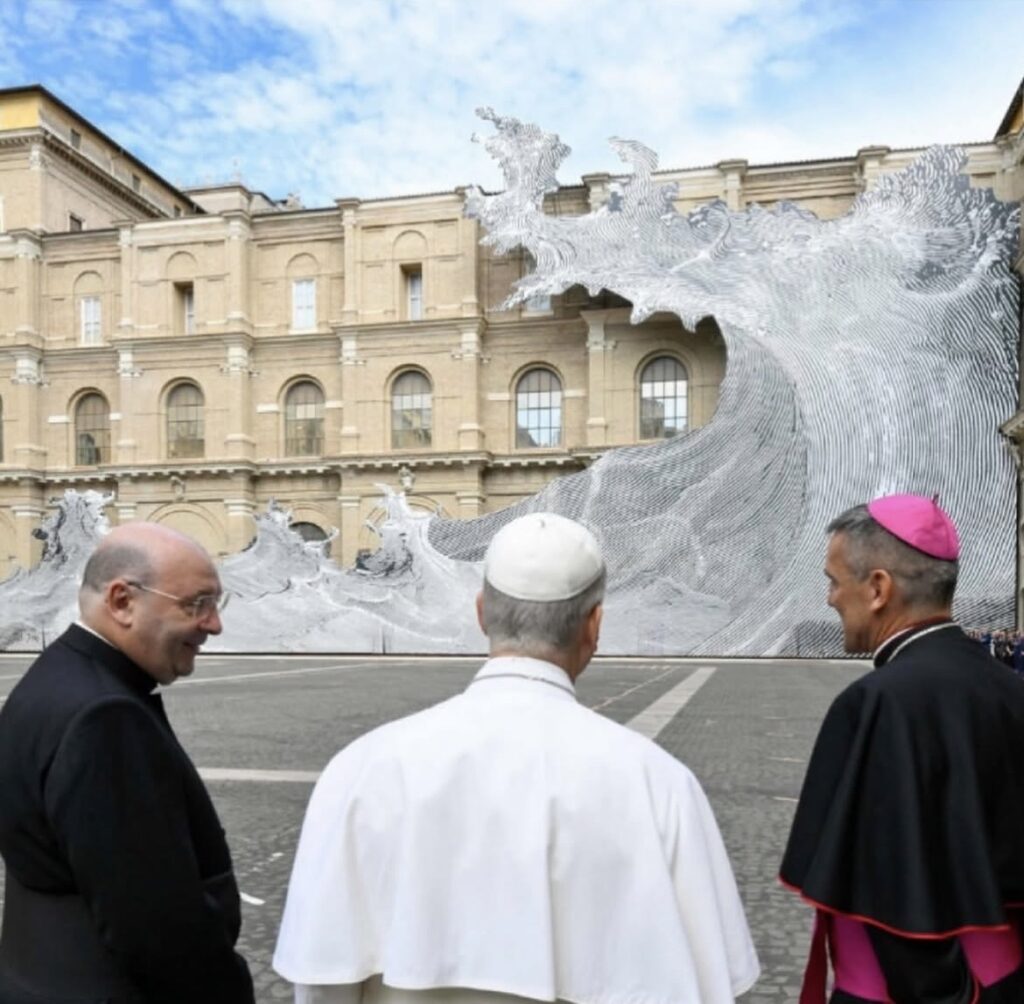
The image of the engulfing wave (above) was recently installed at the Vatican in Rome.
The “happening artist” known as JR makes temporary installations with embedded commentary that he stages with a great deal of fanfare throughout the world. For example, in June he transformed the oldest bridge in Paris into a monumental inflatable cave which he called La Caverne du Pont Neuf.
This week, it was a gigantic black&white wave, splashed across the 16th century facade of the Vatican’s Apostolic Library. It caught the water in “the instant before it seems ready to crash into the architecture,” according to one on-looker, no doubt drawing its inspiration from Noah & the biblical flood.
As the artist explained:
The library at the Vatican came to see me because, for them, water represents their biggest fear. It’s the fact that one day water comes and takes away all the memory … all the traces of a civilization they’ve been preserving.
When such a calamity happens he continued, What do you choose to save?
The question is a timely one.
At a moment when apocalyptic fears abound, I’d argue that once you have a courageous mindset, the choices about what to save—and what to let go of—become almost automatic. That’s because acting on your principles always clarifies your priorities, making it easier to follow-through on those commitments over time. On the other hand, repeatedly avoiding what you know to be right mires even the best of us in a swamp of cowardice.
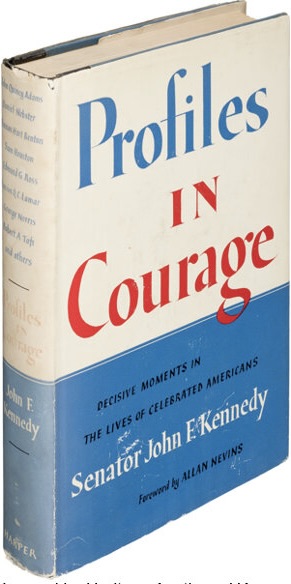
Last Tuesday, while JR was busy chatting-up his new project in Rome, journalist Jacob Weisberg published an important & timely book called “Profiles in Cowardice: A Study of Collaboration in the Trump Era.” It’s a dark twin to John F. Kennedy’s “Profiles in Courage” (1956), which the then-senator intended as a response the Red-Scare witch-hunts of the early 50’s & the malevolent rise of his unscrupulous contemporary, Roy Cohn.
Coincidentally or not, a new Roy Cohn biography also came out this September called “American Scoundrel: Roy Cohn’s Dark Journey from Joe McCarthy to Donald Trump,” written by Pulitzer-Prize-winning biographer Kai Bird & his longtime collaborator Susan Goldmark.
Both books are examinations of frightening & cowardly times that have played out their ugly details about 75 years apart. As glimpsed from the Vatican Library, it’s easy to imagine a similarly sinful world, as described by the authors of Genesis, just before Noah loaded his arc & God cleansed the mess he was leaving behind with a great flood.
From a civic perspective, what should be destroyed & what saved today?
A cleansed & refreshed world begins with a man of courage like Noah. As for the stains that are washed away, they’re Cohn & Trump of course, but what about their collaborators & enablers?
Weisberg’s “Proiles” are not another witch-hunt or holier-than-thou hit job; the author is far more rigorous & nuanced than that. He also brings a whiff of hope to the proceedings, as he explains in a lengthy interview about his book that appeared in Slate last week:
[T]he cowardice has been a contagion, especially in Trump’s second term. But courage can be contagious, too. And when you see on the international stage, and when other world leaders see [Canadian prime minister] Mark Carney standing up [to Trump], and being admired for [his courage, in spite of the costs to him and to Canada]… you think, maybe we’re [all] just gonna have to do this ourselves.
As the next generation of courageous leaders choose what to save from this stained & tattered world, Weisberg argues that the rest of us should consider how several of our most prominent citizens have been enabling our decline over the past 2 years–despite their knowing better.
It’s understanding how the old world happened, so that we can honestly & collaboratively step with our own courage into a new one.
In “Profiles in Cowardice,” Jacob Weisberg examines with skill and more-than-a-little compassion eight prominent though “cowardly” Americans. They are: Supreme Court Chief Justice John Roberts; Amazon founder & Washington Post owner Jeff Bezos; former Senate Majority Leader Mitch McConnell; the most-recent past Republican in the White House, George W. Bush; former chairman of the powerhouse Wall Street law firm Paul, Weiss, Brad Karp; president of Dartmouth College Sian Bellock; influential media personality Megyn Kelly; and private equity titan Steven Schwarzman.
All “knew better” & could have stood up to Trump’s bullying Weisberg argues, but for their own “supposedly good reasons,” each failed to do so in what he calls “the great capitulation of 2025.” With the exception of Karp (who no longer leads his firm, and is the only one who accepted Weisberg’s request for an interview), all persist to this day in failing to act with the civic courage that Weisberg believes is required.
For decades, Weisberg has been sharpening his research, writing & analytical skills at a range of national publications. For a decade beginning in 2008, he was editor in chief of Slate magazine & more recently has helmed Pushkin Press. My personal favorite among his biographical details is Weisberg’s refusal as a Yale undergraduate to accept an invitation to join Skull & Bones (its most career-enhancing “secret society”) because it refused to extend similar invites to the women in his class.
The review of “Profiles in Cowardice” in the New York Times notes (and I’m in full agreement) that Weisberg truly:
investigates the specific situational and psychological forces at play in the moral downfall of each of his subjects, taking care, it must be said, to acknowledge that it isn’t straightforward to resist lawless state power….
[But] n the final analysis, he suggests, the rights and wrongs were pretty clear.
Weisberg told Slate he consulted five factors that constitute “a kind of taxonomy of civic cowardice,” and the extent to which each factor played into these leaders’ choices for themselves personally & for the institutions they represent. For example, he considers each subjects’ “fear of violence” from populist mobs or otherwise if they stood up to Trump. He also examined “pressures from their peers,” “fear of ostracism,” “the financial consequences,” and “long-term impacts for the institutions they lead.” As Weisberg also said at the time, “what I try to do… is put myself as much as possible in the position and the mindset of the person making these decisions….”
In several instances, his subjects did what was expedient in the moment, strangely oblivious to either their long-term personal interests or those of the institutions they served (including a newspaper, law firm, university, political party and the highest office the land). I’ll talk here a bit about the dynamic behind Chief Justice John Robert’s abdication of civic responsibility, leaving Weisberg’s book to explain how he considers his other subjects’ actions (or failures to act) in light of the pressures & fears both they & their institutions confronted from a bullying Trump.
As a lawyer myself & someone who appreciates the gifts that fueled John Robert’s remarkable trajectory, I was particularly appalled by the Chief Justice’s steering of the Trump v. United States decision in July of 2024—particularly after Trump’s first four years in office and when it already appeared possible (given Biden’s disastrous debate performance the previous month) that Trump could very well gain a second term. As you may recall, Robert’s majority opinion in that case makes it nearly impossible to prosecute a president for corruption or other criminal activity either while in office or after they leave the White House.
Nevertheless, seemingly oblivious to Trump’s past & future conduct, Roberts pursued his own objectives regarding executive power & authority instead, says Weisberg in his interview on NPR:
without much regard for the reality of who’s exercising that authority right now and how they’re exercising it…
[On the other hand] I think it’s wrong to see Roberts as a shill for Trump. I don’t think that’s what’s going on, and I don’t think it’s that he won’t draw any lines. I think it’s that [Roberts] is holding back when it comes to restraining the executive in ways that this executive in particular, needs to be restrained. (emphases mine).
That’s because of Roberts’ longstanding intellectual commitment to the theory of “unitary executive power,” namely, that no president’s ability to act should be constrained by either Congress or the Courts unless (as with tariffs) that power is expressly limited by law or the Constitution. But at the same time, it’s an ideological commitment that flies in the face of current realities, causing both me & millions of other Americans to throw up our hands in disbelief about his leadership of the Court.
Here is Weisberg’s interlocutor during the Slate interview, speaking of John Roberts:
He’s not Dumb. And he’s not unaware of what is being burnt to the ground on his watch, but he just has this one play [about the separation of powers] and he’s just gonna play it out to the end….
[IIt goes to this larger point you [Jacob Weisberg] and I are both struggling with, which is the John Roberts that I think I will maintain forever has the highest EQ [or emotional intelligence] on the court, like he knows what’s going on and knows how he is perceived in the world. He can’t possibly be sitting idly by while Donald Trump threatens to steal an election.
But he seems to be be sanguine about it in ways that I don’t understand. And also as you suggest in the book and said just now, seems to be completely sanguine about actual threats against actual judges, about a weaponized Justice Department that walks into court and lies systemically. And those things don’t jibe with the John Roberts I thought I understood. And it’s hard to understand.
You quote Noah Feldman for saying [Roberts] is playing this massive game of chicken where he’s just trying to not, not willingly enter into a constitutional crisis with the President of the United States. But every single time he hands over a truckload of powers to [Trump], it’s an entirely self fulfilling permission structure [for this particular president to try and] grab [even] more.
The ability to finally implement a favored legal theory doesn’t give a leader who knows what’s been happening to this country & its legal system a pass from acting with courage to confront those threats.
John Roberts knows better, and Weisberg is right to label it a grave moral lapse for the Chief Justice to fail to muster his colleagues in an effort to confront Trump’s unprecedented power grabs more directly & more effectively.
Weisberg’s judgments had to sting his subjects, but it’s not only about their past actions or failures to act. He wants each of them as well as others currently in American leadership roles, and (indeed) every citizen of this country, to reach down and find their own civic courage at a time like this.
For example, in his Slate interview, Weisberg worries about what our current military leaders will do (or decline to do) if they’re given an unlawful presidential order during the mid-terms.
In Trump’s first administration, General Mark Milley (chairman of the Joint Chiefs of Staff), Mark Esper (his Secretary of Defense), as well as deep support from below them in the chain of command, helped both courageous men to fend off the president’s worst inclinations before they could materialize. But as we all know, in Trump 2.0, checks like these on his impulses are largely gone. With Hegseth & his retiring of seasoned military leaders at an unprecedented rate, Weisberg told Slate that “all eyes” are on Joint Chiefs Chair Dan Caine, because:
there’s a decent chance now that he’s going to get tested around the midterms [by a reactive Trump if it appears that Republicans will lose.]…But what will Dan Caine do in extremis? It could determine the whole fate of American democracy….
Then Weisberg continued:
I [wrote] this book in part to try to use… shame as a pressure point… [because] these people care about their reputations. They care about how they look, they care about how their children and grandchildren [will] feel about them. They care, at least some of them, about how history is going to view them.
But Weisberg also believes that a sense of civic responsibility must fuel the participation of every American in safeguarding our freedoms because the costs of cowardice are far too high. In this, he also invites our admiration for the citizens of Minneapolis earlier this year, when they “raised their heads above the parapet” to challenge injustices around immigration enforcement in that City.
I’m also reminded of the justly-famous movie-line from Robert Bolt’s “Man for All Seasons,” where Thomas Beckett challenges what he views as his king’s immoral actions. When asked why he’s taken such a risk given their past friendship and the sheer ease of “just going along,” Beckett says: “The only thing necessary for the triumph of evil is for enough good men to do nothing.”
Jacob Weisberg’s excellent “Profiles in Cowardice” is another reminder to leader & citizen alike that courage is always necessary when you know that you’re being pressured to yield to unacceptable demands.
This post was adapted from my September 20, 2026 newsletter. Newsletters are delivered to subscribers’ in-boxes every Sunday morning, and sometimes I post the content from one of them on my websites’ landing page in lightly edited form. You can subscribe by leaving your email address in the column to the right of each post.

