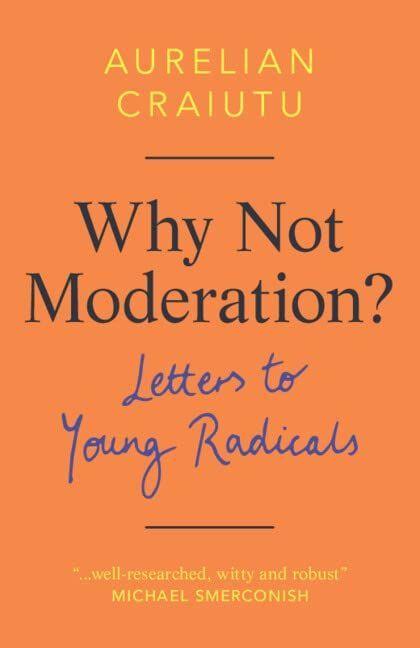
A much-discussed recent book, “Why Not Moderation? Letters to Young Radicals” (2023), couldn’t be more timely.
At a time when much of humanity’s stewardship of our world and its governance seems to be failing, many of us—especially among our youngest generations—are embracing the extreme ideologies of the Left & the Right.
At one extreme, these ideologues end-up being xenophobic, anti-Semitic or racist in their zeal to identify “true” Americans. At the other extreme, they become class-warriors, either socialist or communist in nature.
As Barton Swaim notes in the Wall Street Journal, there’s a reason behind their embrace of these ideological extremes:
[A] generation of young people..long for something more heroic and satisfying than, as they see it, the morally thin lives of their elders.
In the meantime, it should also be said that many who are not-so-young are dispirited too, often to the point of seeking at the extremes the sense of meaning & belonging that tighter communities & organized religion once provided.
While Trump has become the ugly face of extreme politics, the wet & the dry-rot that so many feel these days extends far beyond the outrages of his administration. How America chose to abandon a thoughtful march towards the future since the end of the Cold War accounts for much of the muck that’s been weighing us down, like gutting our industrial base & pursuing costly foreign wars. So a different corrective like “moderation” might feel preferable these days, however old we might be.
But what does it mean to be moderate in today’s politics? It’s a question that’s also worth considering because it’s been decades since we’ve taught civics in this country & even older Americans who once benefitted from its primers could use a refresher course.
In “Why Not Moderation?” Romanian émigré & political scientist Aurelian Craiutu makes the case for moderation “as a political ideal quite as intellectually and morally satisfying as any all-embracing ideology.” He argues for what moderation demands of both citizens (like us) & institutions (like our Supreme Court, Justice Department or police), making his arguments in the gently constructive, non-hectoring way that fits his subject matter.
In this Craiutu mostly succeeds, as I’ll get to a minute. However, the one area where I wished he’d spent more time is where the moderate individuals & institutions in a political society confront an annihilating state of affairs—say, the Nazi’s democracy-killing rise to power in 1930’s Germany’ (which received the immoderate response of a second world war), or the predator capitalism of 1890’s America (that seemingly radical & extreme muckrakers managed to domesticate, atl least to some degree, in the first decade of the last century).
When is immoderate action called-for so that a return to the more moderate middle in political life can be hastened as much as possible? Or to say it somewhat differently, do moderates have to act with the zeal of extremists if they’re ever to succeed in confronting a political death-march?
In coming paragraphs, I’ll get to that question too.
Part of whom I’m writing to today is me, because I’d like to think of myself as bringing a moderate point of view to my politics. But what (exactly) does “moderation” consist of these days?
According to Craiutu, moderation has at least three components. The first is seeking “the mean” between extremes. The second builds and protects institutions that require political actors to reason, argue and compromise with one another, as embodied in America’s system of checks & balances. The last, as he writes, is a heaping measure of modesty.
Moderation is not too sure of itself. There’s an openness to learning from others. There’s a skepticism, an acceptance of the fact that you don’t know the answers, though you search for them….
The world is very complex. There is no privileged access to understanding its direction. You need to look through as many windows as possible. We humans are limited and exhausted and can’t comprehend the world in its fullness —
and shouldn’t fool ourselves that we can. As Swaim observes about Craiutu’s recipe:
the truest sign of moderation is ‘eclecticism’: the ability to hold views or take attitudes to different parts of life that appear, to those who place a high value on purity, contradictory. He cites [with approval] the American sociologist Daniel Bell’s memorable self-description [of himself] as ‘a socialist in economics, a liberal in politics, and a conservative in culture.
At the same time, moderation is not “centrism” or “always compromising.” Instead, it’s a quality of mind that brings both a healthy skepticism and a hard-won resilience to political engagement. On the one hand, as the book’s LA Times reviewer noted: “Moderation relies on our seeing that not all good things go together, making pluralism and balancing [of worthy but often opposing views] inevitable parts of political life.” On the other, as Craiutu himself writes, “it takes a lot of bravery to remain moderate when everyone around you is immoderate and rude,” while feeling superior to you in their certitude.
The author’s own youth in Romania before the Cold War ended also feeds his arguments in “Why Not Moderation?” He has first-hand knowledge of how radicalism, ideology & fanaticism can endanger a democratic framework that makes both personal prosperity & freedom possible. Another reviewer, history professor Michael Behrent, can almost hear him pleading with us, his new countrymen: “Do you even realize what you are throwing away?” when you embrace a “totalizing ideology.”
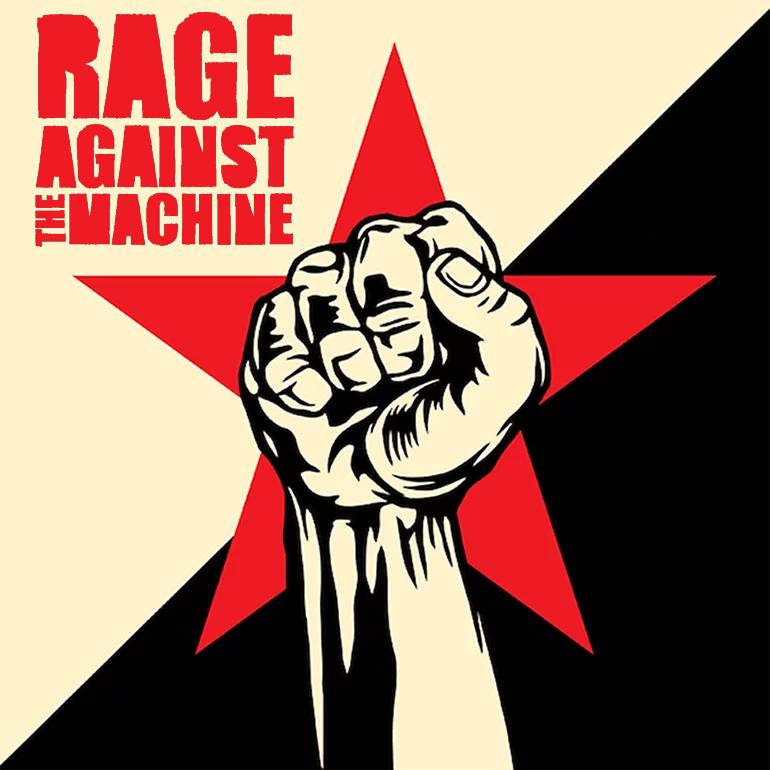
A album cover from the politically-charged Rage Against the Machine.
At the same time, it seems fair to wonder whether the practice of political moderation would have been able to throw off the yoke of communism in his native Romania, or will be enough to counter anti-democratic forces of either the Left or Right if they gain enough power in our own countries (think of the political turmoil in France & Germany today & maybe in America tomorrow, if the mid-term elections in less than a month are successfully corrupted).
At the very least, political moderates will need the out-of-power radicals to help take-on their ideological foes (the kind of diverse coalition that defeated Victor Orban in Hungary last April), so that moderates will be positioned to lead the rebuilding effort that follows all successful challenges to ideological power. With Hungary’s example in mind, I agree with two of Professor Behrent’s gentle criticisms of “Why Not Moderation?”
First off, Craiutu seems to argue that moderate citizens can actually constitute their own political movement, but the fact is that they didn’t in Hungary any more than political Independents in America can do so this November. That’s because the political responses of both Moderates and Independents are always relative to the forces that they’re up against at the moment. No “party” can ever form when its members take such diverse & changing-with-the-challenge positions. As Behrent argues:
Moderation…is inherently transitive. It must have an object. It has to moderate something…[It] is needed when passions risk rendering politics dysfunctional and destructive…[I]t is not another option on the ballot, but [instead] a kind of political first aid—a set of tactics and maneuvers to be followed when extremism threatens the polity’s survival.
In other words, moderates are never more than a force to be reckoned-with by the extremists they aim to frustrate.
Behrent’s and my second criticism is closer to my heart, and to the passions that arise in me whenever I see extremism on the Left or the Right jeopardizing “the political conversation” that has given me back so much in my lifetime.
So, when it comes to my politial commitments I can’t always be expected to default to “moderate & measured” when confronted with “brazen challenges to that conversation,” like Trump’s co-opting of the Justice Department, FBI & immigration system, and his attempts to co-opt American law firms, universities & elections as well as this nation’s press, courts & military. Or, for that matter, being stifled in my work by the Left’s “political correctness” & intolerance to viewpoint diversity.
Moreover, I can’t even imagine how “moderate & measured” I’d be if I believed that American democracy had actually reached a tipping point due to any of the extremists who threaten it. So when it comes to serious threats to, say, American democracy, I think Craiutu is a bit more convinced than he should be that moderation alone will be able to deliver enough of a counter punch.
For example, in his book Craiutu considers Robespierre’s conduct during the French Revolution to be a prime example of radicalism gone amok, and in many ways it was. But then, not always. As Behrent notes, once the Revolution got underway, France was also threatened with a foreign invasion enabled by collaborating French royalists. Faced with such a threat, Behrent asks:
Was it so unreasonable for Robespierre, in such circumstances, to be ‘apocalyptic and alarmist’? When a hostile power threatens to lay waste to your capital, should one plead for ‘negotiation and … necessary concessions to one’s political opponents’?
In other words, should a passionate citizen act “with balance & reason” regardless of the circumstances?
As an aspiring moderate, I’ve already said what I would do (as in my May post called “Why Protest?”) if it appears that Trump is successfully tampering with the outcome of our mid-term elections. I’ll put my body on the line, along with what I believe will be millions of other bodies from civil society, & expect that I’ll act “unreasonably” when I do so, because this time around the circumstances include Trump’s attempt to over-turn the election results in 2022, the subsequent failure by any branch of the American government to hold him accountable, and every other attempt he has been making to co-opt America’s system of checks & balances.
So it is also necessary, I think, to consider the gravity of the circumstances when responding as a political actor, because sometimes acting with moderation can’t meet the threat that presents itself. But still, such planning always begins with the weighing & possible balancing that in every moderate mindset determines whether the threat-level is high enough.
In this excellent & timely book, I wish that its author had considered & discussed the outer edges of moderation at greater length, because with A.I., climate change & the state of democratic self-governance generally, the threats that loom will sometimes call for a more radical response.
This post was adapted from my October 11, 2026 newsletter. Newsletters are delivered to subscribers’ in-boxes every Sunday morning, and sometimes I post the content from one of them on my websites’ landing page in lightly edited form. You can subscribe by leaving your email address in the column to the right of each post.

