It’s a testament to the discombobulation of too many August days that I outlined this newsletter on Friday, deleted all the underlying materials, and then forget to save these marching orders so I could pick up where I left off on Saturday—that is, yesterday.
So much for a turn-key newsletter.
But after rummaging around in my laptop’s trash can, I recovered the best bits, dusted them off & present them below.
Short Stack of Interesting is an occasional series that features stories, points of view & images that caught my attention & lingered there long enough that I began to suspect that you might find them interesting too.
1. Waterfront Living in Holland
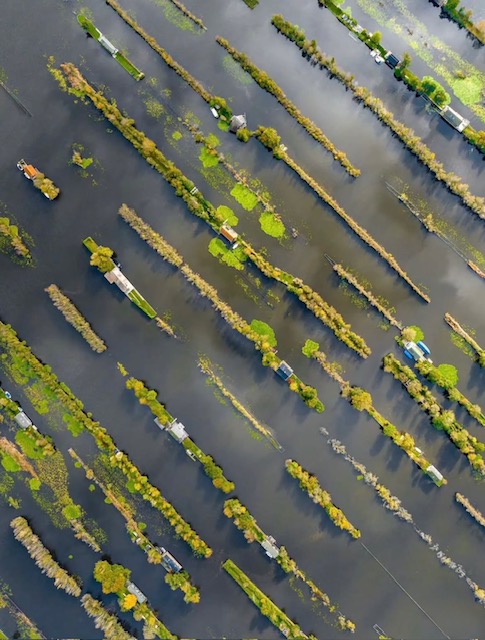
The image up top & those immediately below are of some of the homes that hundreds of Dutch families have built on strips of land that were left from centuries of peat mining. For many of us, living on or close to the water is something of a dream, particularly at this time of year. To my mind, these homes embody that dream more fully than most.
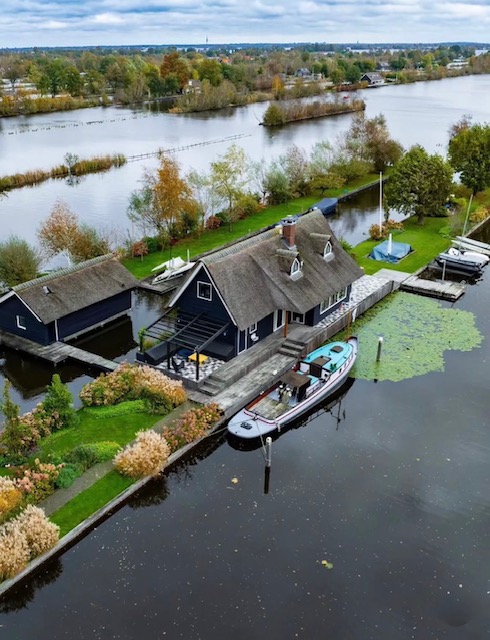
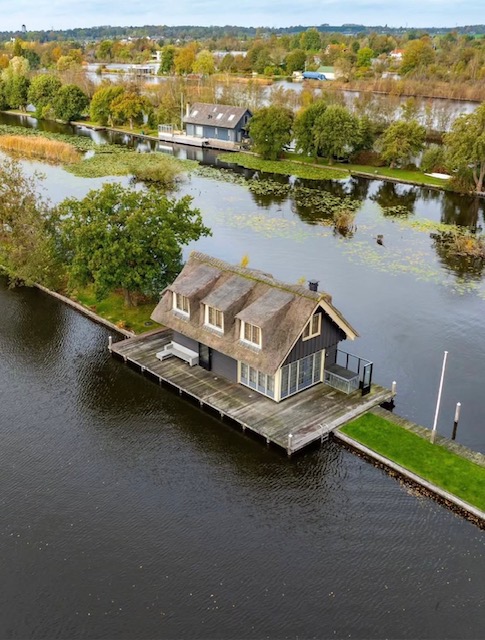
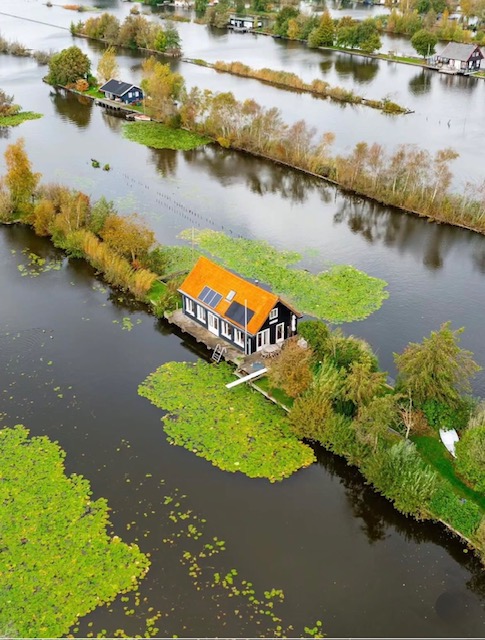
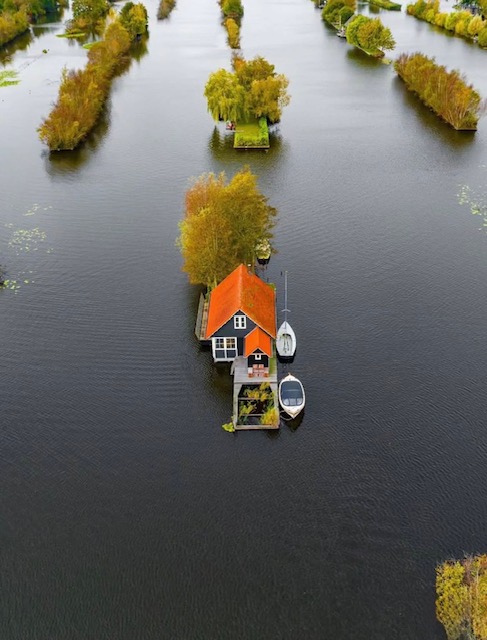
In the Loosdrecht Lakes region of the Netherlands, peat extraction for use as fuel began in the Middle Ages and expanded significantly from the 16th Century onwards. Thin embankments were left between the excavated trenches which filled with water over time. Today these proximities have been transformed into one of the Netherlands’ premier destinations for water sports (think sailing, kayaking and paddle-boarding) as well as waterfront living. Turning a centuries-old industrial landscape into a thriving community highlights the Dutch ability to adapt their “low (below sea-level) country” and to its ever-inundating waters in an enviable way.
2. Nature Finds a Way
For some reason, my social media feeds have been filled with clips of giant tortoises being given back-scratches by zookeepers and pet (?) owners. I probably started watching them because I never once suspected that these incredible creatures could feel something like a scratch through their shells, but apparently they can, enjoying the sensation tremendously.
So I guess I shouldn’t have been surprised by another giant tortoise story, this one involving 2 from a species on the critically endangered list, improbably named “Mommy” and “Abrazzo,” who recently gave birth to sixteen (!!!) hatchlings at the Philadelphia Zoo despite the fact that both parents are estimated to be in the neighborhood of 100 years old, and Mommy is a first- time mom. The full story is told on the Zoo’s website.
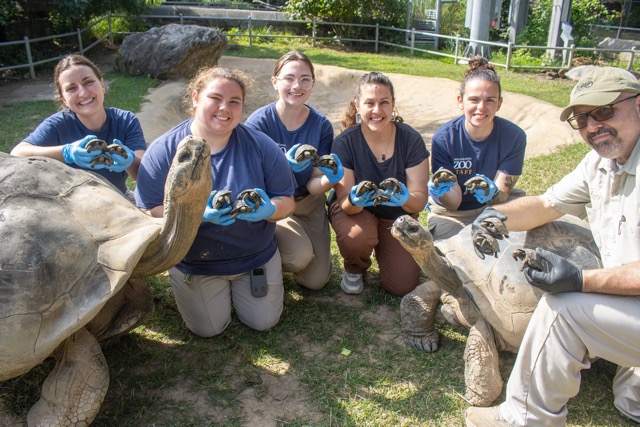
These days, where even zoos have become controversial places for (say) keeping animals like elephants who need larger habitats in order to thrive, we sometimes forget that these institutions have also evolved, becoming incubators for creatures that face extinction in the wild. My hometown zoo has always been one of my favorite local destinations & this story was a reminder that I need to get over there to spend some quality time with one of its newest families.
3. Former Supreme Court Justice Anthony Kennedy Talks About an Essential Book
As last year ended and this one began, the Wall Street Journal invited an array of public and non-public figures to discuss the books they’d read in the previous year. I zoomed in on Kennedy’s comments because he played a unique role in the Supreme Court’s rulings over thirty years, from 1988 to 2018. During that era, Kennedy was the crucial “swing vote” in a vast majority of the Court’s 5-4 rulings on cases involving gay rights, abortion and the death penalty (where he sided with the so-called “liberal” bloc of justices), but even more frequently where he enabled the “conservative” bloc, as in Citizens United vs.the Federal Election Commission, where Kennedy wrote for the Court that prohibiting independent expenditures by corporations & unions violated the First Amendment’s protection of free speech in political contexts. Notwithstanding the outsized impact that Citizens United has had on the role that money plays in American politics, Kennedy’s voice was always a thoughtful & measured one, making his “outside” reading of more than a little interest to me.
In his end of the year comments, Kennedy mentioned a single book, Victor Davis Hanson’s “The End of Everything,” which he described as a “stunning account of four ancient wars that destroyed entire civilizations.” It chronicles how Thebes (in Ancient Greece), Carthage (during the rise of Rome), Constantinople (in 1453) and the Aztec empire (facing the Spanish conquistadors) weren’t undone by military power alone but also by “their gradual relinquishing of the civic virtues and adherence to the rule of law that had allowed them to flourish in the first place.” In other words, their civilizations had been undermined from within before any of them were felled by foreign invaders.
In this light, Kennedy sees 21st Century America as a cautionary tale.
We must not assume that liberty will perpetuate itself or that institutions will function without the trust and discipline of those they serve. The ancient world teaches us that decline rarely arrives suddenly. It accumulates in small abandonments of responsibility and mutual respect. ‘The End of Everything’ instructs us that the preservation of our democracy requires constant attention to the norms of civility, respect for lawful authority and a shared commitment to the dignity of every individual. We are not destined to follow in the paths of the societies Mr. Hanson writes about, nor are we destined to avoid them; it is our duty to take conscious steps to preserve freedom in our present day and secure it for generations yet to come.
A mid-term election in November or our next presidential election (even if both end well) won’t address the vulnerabilities that are undermining our way of life here today. Kennedy argues that only a wider and deeper revitalization of our basic commitments can reduce the civilizational risks that America faces.
4. Shopping Plus History in a Striking New Supermarket
Traveling in Europe is a near constant reminder of a deeper human past than can easily be glimpsed closer to home. European’s also have a greater respect for their histories, something I’m always lamenting as Philadelphia tears down yet another historical building.
So I was delighted by the story of a new supermarket in central Dublin that made multiple archeological discoveries during its initial excavation work. The developers discovered not only an 11th-century structure dating back to Ireland’s Viking era but also the remnants of an 18th-century Georgian theater. Instead of relocating their findings, they made the innovative decision to preserve the ruins in place, installing glass panels throughout the supermarket so shoppers can see their City’s deep historical roots while they move down the aisles.
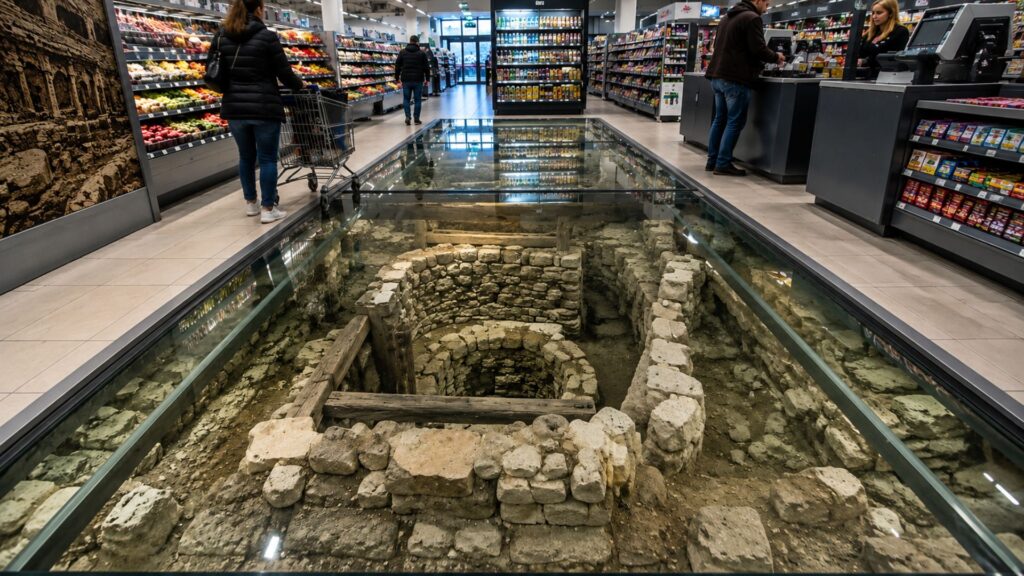
When I visited Rome almost ten years ago, I spent part of my last day at the upscale Rinacente department store, where the basement level showcases the layers of Roman history that were uncovered while building that store. Unfortunately, the picture I took at the time of the ruins failed to capture the time-travel of moving from the top floor cafe through six floors of Italian fashion & design and down to the ancient streets below as successfully as this extraordinary approach in a Dublin supermarket.
5. Who Gets My Collections When I’m Gone?
Baseball cards. Rocks. Shells. Paintings. Prints. Five of these. Seven of those. From the first collections that began when you bent down to fetch something that caught your eye at the beach or during a walk in the woods, sometimes the collecting bug never ends—even when you start wondering what will become of all of these accumulated treasures once you’re gone.
The Times did a thoughtful piece on the sad fate of most collections a few years back. It began with the following testimony from someone at an auction house who constantly hears the complaints of the unfortunate “heirs” who now have to dispose of all of these “treasures.”
More times than I can remember, a spouse or child has said to me, ‘If he wasn’t dead, I’d kill him all over again for leaving me with this mess.
So if you respect not only your inheritors but also the time & enjoyment you gained from your collecting, you’ll want to catalog your treasures in your will, as well as indicating what’s to be done with them once you’re gone.
It’s not really about doing it for the sake of the money, but it’s making sure that the responsible stewardship of your collection extends beyond your life.
That stewardship can mean different things for different people. For one guy who’s collected Superman memorabilia, he’ll trade his funeral (“a total waste of money”) for an invitation to his friends to browse his collection and take what they want.
If I were to die tomorrow, I would like to think that all of them would not mind having a Superman action figure of mine to keep to remember me by.
Others of us would simply prefer that our treasures not end up in a garage sale. Once again, it’s a matter of respect for the time & energy that we’ve spent on them. Collectors know the places where they’ve bought their favorite things & the folks who inherit our collections should be told about them too, as well as what items were worth when we purchased them & what they might fetch tomorrow.
And if your rocks or shells will never be scooped up by a natural history museum, find a boy or girl who has the collector’s glint in their eyes and pass on your treasures for the enjoyment of a kindred spirit. When I was a kid, I got more than one treasure from collectors who’d identified an earlier version of themselves.
There are several ways to give your collections a respectable home when you’re gone—but as with so many other things, you’ll need to do some thinking about how you’ll be providing them with a new home.
6. The Friendliness of Objects
I’m going to drill a bit deeper into our relationship with things with an assist from Alan Jacobs & his Homebound Symphony newsletter. Some months ago, Jacobs elaborated upon philosopher Roger Scruton’s observations about traditions that we’ve maintained for centuries that involve repairing valued objects—traditions that are (sadly) fading away in our throw-away-the-old-one-just-buy-a-new-one culture. According to Scruton:
Repair was not so much a habit as an honoured custom. People respected the past of damaged things, restored them as though healing a child and looked on their handiwork with satisfaction. In the act of repair, the object was made anew, to occupy the social position of the broken one….
The custom of repair was not confined to the home. Every town, every village, had its cobbler, its carpenter, its wheelwright and its smith. In each community people supported repairers, who in tum supported things….
The truth is that repair, like every serious social activity, has its ethos, and when that ethos is lost, no amount of slap-dash labour can make up for it. The person who repairs must love the broken object, and must love also the process of repair and all that pertains to it.
(In a similar spirit, a post of mine from six years ago called “August’s Repair Shop,” elaborated on how Japan embraces traditions of repairing treasured articles of clothing, reliable storage vessels & favorite cups or bowls through sashiko, staple repair & kintsugi—so there must be something about “restoration” and this time of year for me.)
Anyway, Jacobs goes on to make an interesting leap from repairing broken things out of the love for a “friend” to repairing much larger things (also out of friendship), like our education systems or our democracies.
I am greatly taken by the way Scruton frames the work of repair here, especially the idea that the impulse to repair arises from and is sustained by love — and that the particular form of love at work here is friendship. By repairing the things of this world we exhibit friendship towards them — and they become friends to us in return.
People need things, and things need people.
The critical moment of their mutual support is the moment of breakdown…. We get angry at broken things, and want to throw them out — and this impulse often governs us even when the broken thing is not a car or a drain but democracy or education…
But what if we were to think not that our [democracy or our] education has betrayed us but rather that its need is greater than ours? What if we were to think that towards even something so vast and complex we have the obligations of friendship?
And, if we meet those obligations, perhaps we could even enjoy the benefits of friendship.
(I wrote another related post more recently, “Our Work Includes Repairing the Commons of Public Life,” with “the commons” being spaces we hold in common—like parks or sidewalks—collectively sharing them in hopefully unselfish ways while benefitting from their use.)
Thinking about valued objects as well as traditions and even “our ways of life” as friends that we’re obliged to maintain & repair so that we can benefit from their use going forward may just be the beginning of the solution to some of our most existential problems today.
7. The Great Green Wall of the Sahara
I’ll end today on an aspirational note with another story about the obligations & benefits of friendship–this time regarding people who are struggling to live a half a world away.
We hear a great deal about environmental calamities these days but (it sometimes seems) much less about human beings taking environmental responsibility for the places they call home.
I collect tribal art from African countries that are impacted by the Sahara so I follow developments in these countries, including recent reports of the more than 60,000 refugees from this region overwhelming the Spanish enclave of Ceuta last month, Russian mercenaries weakening the government of Mali, and violence from radical Islamic rebels that plagued eastern Nigeria earlier this year. But despite this region’s challenges (and those in the eastern Sahel, like the ongoing war in Sudan), what remains of the global community is also supporting an ambitious project to halt the march of the Sahara desert and reclaim arable land that’s being lost.

The U.N.-sponsored Green Great Wall initiative aims at restoring 100 million hectares of already degraded land, improving food security for residents, creating green jobs, and helping communities adapt to climate change. In other words, it is rebuilding local ecosystems, with millions of hectares—a single hectare being just under 2 1/2 acres—already restored.
Pie in the sky?
While funding bottlenecks, high seedling mortality due to drought, and political instability have stalled the initiative at 20 to 30% completion since its inception in 2007, the initiative continues to advance in many areas, testifying to the resourcefulness of its managers at a time when the availability of farmable land may be the single most important factor in stabilizing local populations & averting an even graver immigration crisis than countries in the northern hemisphere have experienced thus far.
The necessary response isn’t higher border walls and mass deportations that are turning wealthier countries into police states, but supporting projects like this one that enable local communities to sustain themselves so that those who live there aren’t desperate to leave, and reasonable border security can be restored by destination countries.
We hear too much about the immigrant crack-downs & not nearly enough about the often heroic efforts that are being made today to address mass migration’s root causes. The Green Great Wall is one of them, and August may be the best time of year to contemplate the work of our friendlier angels instead of the blame that’s being asigned by our fallen ones.
This post was adapted from my August 16, 2026 newsletter. Newsletters are delivered to subscribers’ in-boxes every Sunday morning, and sometimes I post the content from one of them here, in lightly edited form. You can subscribe by leaving your email address in the column to the right.

