David Griesing | Work Life Reward Author | Philadelphia

  • Blog
  • About
    • Biography
    • Teaching and Training
  • Book
    • WorkLifeReward
  • Newsletter Archive
  • Contact
You are here: Home / Archives for David Griesing

We Find Where We Stand in the Space Between Differing Perspectives

September 16, 2019 By David Griesing 1 Comment

When you hear an argument on Tuesday and its opposing argument on Thursday, it’s always a challenge to arrange a further date where you can line them up at opposite sides of the room while you sit in the middle to figure out what you think and feel about the issue. Rescheduling your attention like this always seems to get lost in the shuffle.
 
On the other hand, the opportunity to listen, process and react almost immediately to opposing points of view is what can make live debate and virtual encounters with discordant perspectives both clarifying and satisfying.  
 
They may also be ways to move beyond the polarizing shouting matches that characterize much of American democracy today.
 
When an issue “gets joined” you can figure out where you stand either on the spot or while continuing the conversation with yourself and others immediately thereafter. All you have to do is build this new information and its subtleties into your own perspective once you’ve had the chance to sleep on it. 
 
When it comes to processlng opposing views, time compression seems critical. Being part of a live audience interacting with live “actors” or encountering real people in a virtual world is too. Another factor is your decision “to make yourself available to their persuasion” by the physical act of showing up, something you rarely do when you’re watching people testify on the other side of a screen. On each of these “live” or “almost alive” occasions, you’ve chosen to immerse yourself in a world of different perspectives where you’re open to changing your mind. 
 
A final factor is also critical. Theater that is built on counterpoint stories and virtual worlds that make us confront our own preconceptions are jarring experiences. Both demand that your thoughts and feelings connect across a broader waterfront than you recognized before. They challenge moral certainties and provide building blocks you can use immediately to construct a more nuanced point of view. Their wake-up calls can often make you behave differently too—impacting the jobs you do as community members or citizens. They offer highy engaging ways to figure out where you stand and what to do next.
 
All of these dynamics were apparent in a recent theater production in Portland Oregon, where actors playing members of the community and its local police force held the stage in front of an audience from that same community, told their distinctive stories and changed some minds.
 
Similar changes in perception became evident when people put on the virtual reality (VR) headsets that were recently developed by a California company. VR technology can take you places and put you among people you may think you know about until you are literally walking among them at Rikers Island prison, on the US-Mexico border, or in a Syrian refugee camp. 
 
What used to seem black and white and came cloaked in moral certainties can be shaken into reconsideration by these “live” or “virtually alive” experiences. Abstraction and over-simplification are no longer quite as possible when issues that we thought we understood have faces. Once we’ve learned more and have the experience to know better, we may no longer wish to view ourselves (or be viewed by others) as being so cold in our certainties or so removed from the blood, sweat and tears of most people’s lives.
 
Do these kinds of experiences offer a way to move past the knee-jerk polarities that undermine our collective purpose? 
 
Are they vehicles for helping at least some of the undecided and disengaged in this country to make up their minds and help build a future that they want instead of leaving their prospects to others?

Finding Shared Human Perspectives While Looking At and Listening To One Another

The chasms between diverse communities and the police who are charged with protecting them yawn widely across America. In Portland, some creatives in the performing arts and forward-thinkers in law enforcement came together to try and reduce them. Their approach: a stage adaptation of the dueling perspectives, only this time with several rarely heard points of view along the stark divide—including the witness provided by minority police officers who, in more ways than one, have come to embody it.
 
Much of this story about perspective building in the community, and all but one of the quotes here, come from a PBS NewsHour segment that ran on the same day in August that New York City police officer Daniel Pantaleo was fired for his involvement in subduing Eric Garner, an arrest that ended in Garner’s death.
 
Kevin Jones and Lesli Mones founded the August Wilson Red Door Project, a theater company, to provide a platform for addressing issues of importance to the City’s African American residents. The other driving force in this story is Robert Day, the former deputy chief of the Portland Police Bureau. Jones and Mones asked him to gather perspectives from policemen who serve in minority neighborhoods like theirs and he pursued their invitation with relish. 
 
What ultimately came together in one performance were a series of monologues from two different plays. “Hands Up” was written by African Americans about their experiences being racially profiled by police. “Cop Out” tells the stories of individual police officers when they are wearing their uniforms as well as the lingering effects after they take them off. 
 
Jones and Mones each described the intent behind bringing witnesses from both perspectives onto a single stage. Said Jones:

We’re not dividing the story into two sides, right, the good guys and bad guys. On both sides, we have a group of people who feel that their stories are not being told, that they’re being vilified, that they’re being shunned, that — and nobody wants to really hear their story.

For her part, Mones addressed early criticism she’d heard from the African-American community in an earlier interview with the Portland Mercury:

From a social power perspective, you can’t compare the experiences of the two groups of people. But from a shared human perspective, the feeling of being unseen, depersonalized, and stereotyped is something both groups can relate to. It’s in the DNA of Red Door to honor a multiplicity of viewpoints, because we know it’s imperative in producing a healthy racial ecology for the community.

Four excerpts from the monologues suggest the power of this “shared” and “deeply human” approach.

– Community member:  ‘They slammed me to the ground. One of the officers had his foot on the back of my neck. Another officer pointed a gun to the back of my head and said, ‘Move one inch and I will blow your head off.’ Oh, I went into survival mode. I tried to convince them I was one of the good ones.’
 
` Policeman: ‘I used to think nothing about being a cop would shake me up. But when you arrive on scene and watch your partner pull an infant out of a microwave because his meth head father couldn’t stop the kid from crying, your lens gets colored.’
 
– [A community member asks everyone in the audience to raise their arms in the air]:
 
A voice representing the police: ‘Hands up.’
 
Members of the community: ‘Don’t shoot.’
 
A voice representing the police: ‘Hands up.’
 
Members of the community: ‘Don’t shoot.’
 
-Policewoman: ‘The only reason I carry a gun if for protection, primarily mine, sometimes yours, sometimes, in highly specific circumstances, like an active shooter, or –no, that’s about it.’

The theater company is hoping to take performances of these combined monologues across the country, starting later this year. However, the fundraising and logistical hurdles that need to be surmounted before the show can hit the road are daunting. But no one provides a better reason for persevering than former deputy police chief Day:

We’re touching on sort of the third rail conversations of race and policing. And I think they are conversations that are happening in African-American families in homes and communities, and I know they’re happening in police communities, because I have heard them, been a part of them, I have seen them.
 
But they’re not happening publicly, and they’re not happening generally across from each other, because of the sort of high-voltage nature of them. So, the theater allows us to put it all out there. We can speak what has been left unsaid.

Only when “it’s all out there” and being processed by the folks in the audience who are most impacted by it can there be any hope of actually “seeing the other,” identifying shared objectives, and pursing them together.

The Issues Are No Longer Vague. They Feel Like Lived Experiences

With VR or virtual reality, the divides aren’t personified on a stage and the processing doesn’t begin when you’re seated in front of it. Everything you need for your views to be jarred into a broader perspective is brought into the perceptual space “between your ears” by this advanced technology. 

Emblematic is a VR studio that was founded by Nonny de la Pena and is based in Santa Monica. De la Pena was profiled as one of 2018’s top innovators by the Wall Street Journal, both for developing groundbreaking VR technology that enables you to feel like you’re moving through a real space (instead of just standing in it) and for the rationale behind her inventiveness.

The author of the profile explained her intentions this way:

The idea is to put people in places they wouldn’t normally find themselves, experiencing situations they would not normally experience. Often, these are related to urgent issues, issues that are, in their sprawling complexity, seemingly difficult to grasp or even care about. But suddenly, there you are, standing in a cell in solitary confinement, or at the foot of a melting glacier, or before a protest line outside an abortion clinic. When you are in these places—hearing the anguish of a prisoner, the calving of a glacier, the vitriol of the protesters—the issues no longer seem like issues, with vague names attached, like prison reform or global warming or women’s health. Rather, they seem like lived experience, like people you’ve met and places you’ve been—like memory.

Within Emblematic’s VR headsets, the perspective you’ve brought with you is jarred by the unfamiliar in “real” time and you’re invited to start responding immediately to the flood of new information that’s washing over you. Particularly when you enter environments with other people in them, it feels like you are entering a reality as it’s being lived by someone else, providing unprecedented opportunities for connection and empathy.  
 
Before you put the headset on, you also know where you’re going and have made yourself available to broaden and deepen your point of view. You find a new place to stand in the neurological mindspace between your thoughts and feelings about this issue before and the virtual experience that you’re having now. As long as it’s programmed as an exercise of free will, this technology can help you to make up your mind or intensify your most important commitments.
 
Unlike the challenges of putting the “Hands Up/Cop Out” show on the road, the financial and logistical challenges for de la Pena and Emblematic are likely making their technology cheap enough and portable enough that it can someday travel on its own to wherever people are undecided or simply want to know more. They (and other monitors) will also need to mind the gap between its use for illuminating an increasingly complex world and simply manipulating our reactions to it.
 
Sometimes, groundbreaking innovations like de la Pena’s have their roots in childhood, and so it is with the story of how she first learned the value of differing perspectives–even when one of them is hers. The Journal’s profile of her actually begins with it:

When Nonny de la Peña was in junior high, in West Los Angeles, her math teacher wrote a note home to her parents. ‘It was about something I’d rebelliously done,’ she says. ‘It was something minor, like speaking up, or speaking too loudly.’ Her father read the note, then turned the paper over and looked at her. ‘This is what she says you do, he said to me,’ de la Peña recalls. ‘Tell me about her. What does she do?’  De la Peña listed some of her own unflattering observations about the teacher, and her father wrote them down on the back of the note, so that now the piece of paper contained two notes, two different perspectives. Then her father signed it. ‘So what does that make you do? Of course [says de la Pena], it makes you think about the structure of things…. Of how situations are multidimensional.’

Her father knew, and early on it seems that she came to know too, that the truth can usually be found somewhere in the space between perspectives.

+ + +

I’ve written before about the space “where we can make up our reasonable minds” because I’m concerned (and sometimes alarmed) about how our demonizing of those we disagree with has disabled us from building anything of consequence in America today. It also comes from how others’ “not caring enough to have points of view” further undermines “what those who do care enough” hold in common. These sentiments were behind my post on the remarkable public exchange between two academic friends, the left-leaning Cornel West and the right-leaning Robert George, and what we all gain (but seldom enjoy today) from politically charged conversations, as well as another about the clarifying nature of dissent.
 
These arguments (and the one today) feel personal to me.

When I abandon my reasoned points of view, or don’t bother to come up with them anymore, I cede control of my future and my family’s future to somebody who may know less and care less. As long as I hold this right and it has not been taken away from me by those who want to control my mind, I’d be a fool not to exercise it.

Where I decide to stand and what I decide to do about it in the work I do and the way I live are among the most valuable contributions that I can make to myself and others. As long as it’s mine, I’ll continue to find the space for evolving my perspectives because it’s part of feeling alive.
 
This post was adapted from my September 15, 2019 newsletter. When you subscribe, a new newsletter/post will be delivered to your inbox every Sunday morning.

Filed Under: *All Posts, Being Part of Something Bigger than Yourself, Being Proud of Your Work, Building Your Values into Your Work, Continuous Learning, Work & Life Rewards Tagged With: August Wilson Red Door Project, collective purpose, common humanity, dieengagement, evolving perspectives, live performance, Nonny de la Pena, perspective, place to stand, point of view, polarization, political polarity, virtual reality, VR

Maybe Uber Drivers Can Handle Amazon Deliveries Too

September 9, 2019 By David Griesing Leave a Comment

These days it seems like companies are pawning off as many risks, costs and responsibilities on workers as they can get away with. It’s particularly apparent among new gig-economy workers like Uber and Amazon drivers. The on-going transfer of economic burdens from companies to workers is a principal reason why many (and maybe most) Americans feel economically vulnerable today. 

At its heart, this is an ethical problem. Where do flourishing workers (families and communities) fall on our list of national and local priorities? Until very recently, the answer was “pretty low,” which is a key reason why there was such widespread discontent around the 2016 election and why it continues to unsettle our next one. Too many Americans feel that the economic security they have painstakingly built for themselves is being assaulted from all sides.

Since the 1980’s, government policies have massively favored businesses over workers, families and communities. This is simply a fact.

That preferential treatment includes policies that dictate who (between companies and individuals) pays and does not pay taxes, and how much each one of them pays. It includes lax enforcement policies that have enabled our most innovative companies (like Google, Facebook and Amazon) to achieve marketplace dominance by eliminating their competition and, in effect, operate however they want. It is also explained by the declining counterweight of organized labor and (until this year) by open trade policies that found the cost of an American worker directly competing with the cost a similar worker in China, Vietnam or Bangladesh. 

The net of these (and similar) forces over the past 50 years is that each American worker has been progressively owning a smaller and smaller share of the nation’s wealth given how little she’s compensated for her labor, while also being asked to pay more than she should for many “goods and services” in our consumer-driven economy. In other words, she’s being squeezed at both ends.

It’s hardly a recipe for flourishing workers, or for the families and communities across America that depend on them to thrive. 

Given the on-going, anti-workforce trend, I’m not being entirely facetious when I suggest that Uber drivers could be asked tomorrow to handle Amazon deliveries too. When all that we seem to care about is maximizing an Uber’s or an Amazon’s profits, an additional demand like this on gig-economy workers hardly seems out of the question. Why not pile even more onto them?

No wonder the social fabric feels like it is unraveling on the backs of the individuals (like you and me) whose strength it depends on at least as much as the companies that have organized and rallied us in profit-making directions.

         The Shift of Risks, Costs and Responsibilities to Workers Continues

Recent stories about workers at Amazon and Uber illustrate the exploitation and vulnerability that are all-too-familiar by-products of working in America today. Not only is there little-to-no safety net around these and other gig-economy workers; but more and more economic risk is continuously shoved onto them by companies that champion profits over paying their workers enough to provide the bare necessities for their families.

If you drive for Uber (or for one of the other car service companies) you’re probably no longer surprised when your passenger wants you to take him to the hospital with a medical emergency. According to a recent University of Kansas study and several recent podcasts picking up on it, Uber cars are commonly used as ambulances because in many parts of the country, taking an ambulance to the ER is not covered by health insurance and can run into the thousands of dollars. As a result, Uber drivers are being called upon to shoulder the financial responsibility (as well as the stress) of ferrying people who are often in extremis to emergency rooms across America. Of course, they never come close to recouping these psychological and risk-laden “costs” in their ride-hailing fees.

A mid-August op-ed in the Wall Street Journal describes another way that Uber drivers end up paying in ways they never contemplated. Few of these drivers appreciate that they are failing to recoup anything that even approximates the depreciation in value that comes from using their private cars—an amount the authors calculate at $11 billion a year, and another burden that Uber is off-loading onto its workers.

Once drivers understand that they are liquidating the value of their vehicles, in effect receiving pay-day loans with their cars as collateral, the effects may be significant. Companies like Uber, Lyft, Grubhub and Door-Dash may find it more difficult to recruit and retain drivers unless they raise prices and pay drivers more.

Another recent article decried how Amazon has exempted itself from any financial responsibility for its drivers who get in car accidents while they are making deliveries to Amazon’s customers. It is the delivery-driver’s car insurance (and his rising premiums) not Amazon’s that bear this expense. Under a clause in the driver’s contract, company profits are shielded from liability for personal injuries and property damage during the company’s delivery-related accidents. Of course many if not most drivers fail to realize that they have “accepted” this responsibility until it’s too late.
 
This summer, journalists at the New York Times also focused  on the working conditions at Amazon’s cavernous regional warehouses, where its employees toil side-by-side with increasingly nimble robots to ensure that the book or toiletry you ordered gets into the right box. One terrifying down-side in this “who’s more efficient, the human or the machine?” type of workspace, is the extent to which live employees are monitored down to the minute in the quest for almost robot-like efficiency throughout their shifts. In addition, because many fear that their jobs will be replaced by their robotic co-workers one day, they strive to meet an automaton’s level of performance to demonstrate their continuing value as employees.

Ironically, these Amazon warehouses are called “fulfillment centers,” but certainly not for the men and women who are becoming stressed out and broken down by working in them. Moreover, when considered in light of “morally acceptable work standards,” it seems fair to ask whether “free” deliveries, “same day” deliveries and customer convenience can be justified when the worker (family and community) costs are this high. 
 
Beyond Uber and Amazon, all of us are either moving from work towards retirement or have already retired. That’s what makes the next story—about home health workers—both heartwarming and chilling. 
 
Mostly women and often minority women, home health workers are the caregivers for millions of people who are still living at home but find themselves burdened by illness, disability or advanced age. These are “whatever-is-required” kinds of jobs, including feeding, bathing, administering medication, providing companionship and ensuring their clients’ personal safety and integrity. Home health workers are literally sustaining people’s lives, yet they struggle as a group to receive “a living wage” in exchange for their long hours and humanitarian service. 
 
As more people live to advanced age but want to avoid long-tern care facilities by staying at home, these health workers will be in even greater demand, but even the groups that are most likely to need their services are not calling for them to receive adequate pay. I, for one, would not want to hope that I’ll receive compassion when my caregiver isn’t being respected enough or paid enough to provide it. But still, according to the reporters in this story, most of these home health workers are, in fact, providing it. That means these women are, in essence, receiving pay-day loans with their human decency as collateral so that the health care companies that employ them can make as much money as possible. It’s one more shameful tradeoff.
 
Many American workers are also parents providing for their children. But according to a New York Times story last week, 67% of the 1000 parents surveyed said they had gone into debt to buy their children necessary items such as food, clothes and food, and 69% of them said that they kept these child-related debts a secret. 
 
Part of the reason that the economic insecurity of many (if not most) Americans has stayed below the radar is that many (if not most) Americans are either too proud to talk about it or too embarrassed to admit that they’ve failed to realize the American Dream. But their anxiety is real. It is manifest in our politics, and the full extent of the problem will (quite literally) “come home to roost” when the nation enters more turbulent economic waters or we find ourselves in the next recession.

It’s time to strengthen the social fabric with sound economic policies

While we have been victimized as “workers” and “families” by 50 years of government policies that have mostly favored business, we have also been victimized as “consumers,” right down to today.
 
This country functions on the proposition that we will bring our paychecks home, pay for our families’ necessities, and spend much of the rest buying what our consumer-oriented companies produce. Well, it turns out that in many instances we are overpaying as consumers too.

Because policy makers have largely failed to ensure healthy competition between companies through strategic application of the anti-trust laws, several companies in rapidly growing sectors of the economy have achieved near total market dominance—and the pricing power that comes with it. In other words, in an uncompetitive marketplace, dominant companies can charge consumers more (and sometimes far more) for their goods and services than they could in a more competitive one. This appears to be the case in the market for cell-phone plans.
 
In recent decades, regulators have allowed the cell phone service market in the US to consolidate. As recently as a few months ago, regulators allowed T-Mobile and Sprint to merge, reducing what little competition there had been even further. Well, a Wall Street Journal column this week highlighted a recent study showing that Americans, on average, pay 27% more than their French counterparts for cell phone service. The difference between the US and France is that the French enjoy a far more competitive market for these kinds of plans. On the other hand, when you allow markets to consolidate and grow un-competitive (as the US has done) higher prices are one of the consequences, but not the one one for individuals. As the study’s author notes:

declining competition has raised profit margins [for companies] and prices [for consumers] while reducing workers’ share of national income in the U.S.  By contrast, the labor share [of France’s and the rest of the EU’s economic prosperity] has remained constant in Europe.

What this means is that our piece of the economic pie as workers has also been reduced by the lack of competition at the very same time that the prices we pay as consumers are higher, and sometimes much higher than if there were more, say, telecommunications companies competing for our business.
 
All of this adds up to economically vulnerable and anxious Americans, whether they are viewed as workers, parents, community members or consumers.

While focusing on gig-economy workers in particular, a recent post here argued for “re-bundling” benefits around them to account for their occasional unemployment or uneven income streams, their loss of traditional health and retirement benefits, and their inability to obtain financing without a traditional 9-to-5 job. To the extent that these “new economy” jobs are likely to become even more plentiful as automation replaces “old economy” jobs, the wide-spread absence of a safety net like this threatens social stability and cohesion. But as the stories above suggest, the anxiety and economic insecurity is hardly limited to gig-ecocomy workers. Instead, it affects nearly all but the very richest Americans. 
 
The good news in this troubling story is that the imbalance may finally have begun to right itself.

A New Political Force for Workers and Consumers?

There are reasons for cautious optimism because of a recent action from within the business community. Last month, the Business Roundtable, comprised of the CEOs of America’s largest companies, issued what it called A Statement on the Purpose of a Corporation.

In a sharp break with the past, this Statement expressed a “fundamental commitment” to all of a company’s stakeholders: putting employees, suppliers and communities on a pedestal that once belonged only to the company’s investors (or shareholders). On “investing in employees,” the Statement said:

This starts with compensating them fairly and providing important benefits. It also includes supporting them through training and education that help develop new skills for a rapidly changing world. . . Each of our stakeholders is essential. We commit to deliver value to all of them, for the future success of our companies, our communities and our country.

If a core group of America’s most prominent business leaders (181 of them, in fact) makes good on this Statement, it will not be for altruistic reasons alone. A comment at the time in Axios which was called “CEO’s Are America’s New Politicians” lists several of the reasons that following through with corrective policies would be in these companies’ best interests too and not just a paternalistic gesture. Among other things:

–  Millennial employees demand their employers stand for something beyond profit;
 
–  It is getting harder to recruit and retain talent, especially tech talent, if profit is the only objective;
 
–  A rising number of consumers make purchasing decisions based on a company’s social purpose;
 
–  The media applies a lot more pressure on CEOs to take positions on political topics, such as race and immigration;
 
–  Every CEO/company is vulnerable to split-second, social media uprisings. Undefined CEOs and companies find it impossible to push back. 

The Roundtable’s corporate leaders are also aware that the desirability of “the capitalist system” that they safeguard is itself being debated in the run up to the next election. And finally, many of them seem to realize that acting on the Statement’s promises is the right thing to do given the imbalances that have grown between their companies and Amerca’s workers/ consumers over the past 50 years.  
 
What advocates for a flourishing workforce (and the families and communities they support) need to do is hold these corporate leaders to their noble sounding but still generalized promises. This business community needs to generate specific policy proposals and then put their considerable lobbying clout and bully pulpits behind them. For our part, we need to hail their efforts in our public statements and at the ballot box, if and when (as I hope they do) those efforts get underway.

+ + +

It is hard to escape the conclusion that America’s social fabric is both loosening and fraying. Much of the reason for this breakdown is the growing tide of economic anxiety and insecurity that has resulted from a half century where American business has gained while American workers and consumers have lost. In the political season ahead, each one of us will have many opportunities to support what is important to us. My argument is that we need to begin with thriving workers, families and communities.

This post was adapted from my September 8, 2019 newsletter. When you subscribe, a new newsletter/post will be delivered to your inbox every Sunday morning.

Filed Under: *All Posts, Being Part of Something Bigger than Yourself Tagged With: BRT Statement, Business Roundtable Statement on the Purpose of a Corporation, competition, consumer, economic anxiety, economic insecurity, flourishing workers, gig economy workforce, gig-economy workers, re-bundling of worker benefits, safety net, thriving workers, work, worker, workers, workforce

The Discipline of Limits

August 5, 2019 By David Griesing Leave a Comment

Creativity needs limits, like when it happens within a window frame. Accomplishing anything worthwhile needs limits too.  But it’s remarkable how little what we hope to achieve is constrained by our limited resources and true priorities. 
 
When you step outside and it’s 109 degrees in the full bloom of humidity, those limits are dictated by the weather—and it’s a sweaty, grungy mess to fight them. The only workable solution is to pare back, accept what you cannot change and adapt to it. What a relief it was recently to put some of my “To Do List” items into a box called “September.”
 
Our hopes seldom conform to reality however. In watching the presidential candidate debates this week, many of the visions on display seemed unconstrained by limits. Limited tax dollars. Limited attention spans. Limited appetites for 4 more years of disruption.  

30 seconds to respond to a complicated debate question deprives every answer of context, but even when you dig into these politicians’ policy pronouncements, they tend to be individual, grand proposals as opposed to a considered appraisal about how all of their promises could ever be realized. A workable vision says: “I’m going to try to achieve this one big thing with the understanding that I won’t be able to accomplish this, this and that.” Instead, with many candidates, it seems like they want us to believe that they’ll deliver every pie they’re throwing into the sky.
 
In one of the working chapters of my book, I ask readers to use their journals to list the 10 most important things they are working for. As examples, I propose things like: sending your kids to the right school, buying a home of your own, or having enough time each day to play with your dog. Limiting your choices to 10 is the challenge, because what doesn’t make your list is as critical as what does. Since none of us can “have it all,”  the reality (and the magic) comes from how you negotiate the trade-offs.  You are deciding what is most important to you and, by necessity, what is less so.  
 
While thinking about writing to you this week, I came across the following on Twitter. It is from the Collaboration Fund, a venture capital firm based in New York City that describes what it does with a clever tagline:  collaborative = (people x stuff) + new technologies ^ creativity.  On July 24, @collabfund posted these alternate ways of feeling rich:

Alt forms of rich: 

You can go to bed and wake up when you want to.

 
You can buy any book you want. 
 
You have time to read those books. 
 
You have time to exercise. 
 
A short commute. 
 
No dress code seven days a week. 
 
Liberal use of the thermostat.

Somebody @collabfund was using the month of August to look at what is important to them, and (it seems) what is less so.

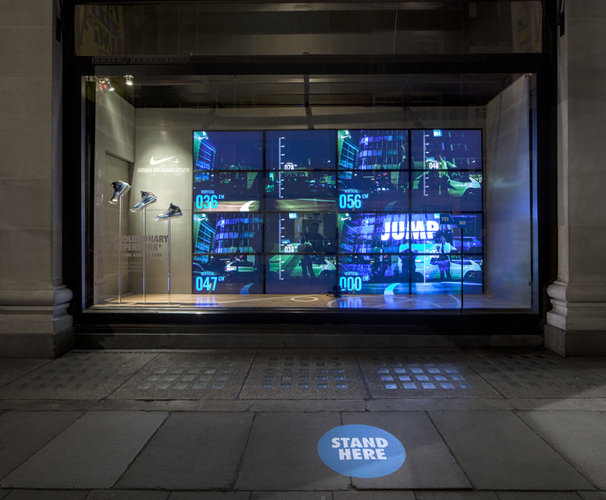
When a motion detector senses someone passing by, the balls move in an accompanying wave motion. Dutch studio Staat designed this window (along with the others pictured here) for Nike at Selfridges in London.

Department store windows present endless opportunities to maximize creativity within limits. It’s what’s included and everything that’s not.

By necessity, you have to tell your story within the window’s frame, and one of the genius elements in this Nike campaign is how they’ve interactively included everyone who is walking by in their frames. The image on the top of the page shows the designers inviting passersby to stand on the illuminated spot, jump as high as they can, and see their effort—in comparison to every other effort—light up on the window’s scoreboard. The step-by-step wave action of the colored balls above is another demonstration of how much can be accomplished within the farther limits of a street-facing window.

This is also the genius in every values framework, whether it belongs to Montaigne, Spinoza or Henry Adams (three that resonate strongly with me) or in the working equivalents that everyone who grapples with a “most important to me” exercise comes up with. It’s a winnowing of priorities.
 
Frameworks like this generally start with one or two key values that dictate the kinds of things that people identify as foundational for them. If you start with a value like “personal freedom,” certain priorities tend to  follow. “Material security” would have you pursuing a very different set of goals with your limited time and effort, while “a healthy world” would yield other benchmarks, like lots of exercise and time outside..

Once you adopt a values framework that fits you, its discipline imposes the necessary limits. If I am focusing my energy and resources on this, I either cannot do this other thing at all, or have already accepted that it will be accomplished with the time and energy I have left. When it’s operational, a values framework imposes its equilibrium like a 109-degree day.
 
One of the reasons I became interested in ethics is that sometimes/ oftentimes I want to accomplish everything I’ve put on my plate. It’s a recipe for meltdown because you’re always behind your own 8-ball. So at the same time that I’m drawn to ambitious people with compelling visions, I’ve learned the hard way to be skeptical when it sounds like too many dreams and too little reality.
 
This hard-fought wisdom is why I loved parts of Christopher Demuth’s recent speech to conservative policy makers. Demuth is a distinguished fellow at the Hudson Institute, an organization that “challenges conventional thinking and helps manage strategic transitions to the future.”
Demuth’s speech was about the advantages of nationalism, and I found that it effectively challenged my more conventional thinking, particularly when he said:

An important virtue of the nation-state is that it is a constraint. The contemporary peaceable nation takes what it is given—its borders and territory and resources, its citizens and tribes, its affinities and antagonisms, its history and traditions and ways of getting along—and makes the most of them….
 
One of the most arresting features of modern life in the rich democracies is the pervasive rejection of the idea of natural constraint. One sees this throughout culture high and low, social relations, and politics and government. Where a boundary exists, it is there to be transgressed. Where a hardship exists, it must be because of an injustice, which we can remedy if only we have the will. Today’s recipe for success and happiness is not to manage within limits and accommodate constraints, but to keep one’s options open….
 
I do not know where this impulse came from. Perhaps wealth and technology have relieved so many age-old constraints that we have come to imagine we can live with no constraint at all. Whatever the cause, it is a revolt against reality. Resources are limited. Lasting achievement is possible only within a structure. My own favorite field, economics, is out of favor these days, but it has at least one profound truth, that of opportunity cost: Everything we do necessarily involves not doing something else….
 
The American nation-state is rich, powerful and less constrained than any other, yet it is much more constrained than we have led ourselves to believe. Thinking of ourselves as a nation-state is, as Peter Thiel has observed, a means of unromantic self-knowledge. National conservatism, by directing our attention to our nation as it is—warts, wonders and all—is a means of reminding ourselves of our dependence on one another in the here and now, and of facing up to the constraints that are the sources of productive freedom.

Does this mean we can’t aspire to do better within our national boundariess? Of course not. At the end of the day, it simply means that in governance—as in our lives and work—it is a question of advancing productively on what’s most important to us much closer to home.

In this regard, I’d argue that those who aspire widely and dream expansively in politics are like the dissenters in my June 3 and June 10, 2018 posts, pulling “the less-decided middle” in their direction. On the other hand, these dissenters are rarely the ones who can also bring enough citizens together so we can move forward and actually accomplish something. That kind of consensus building requires a different skill set entirely, and it’s that unromantic man or woman who can help us “manage within our limits” that I’m hoping to find in the current crop of candidates.
 
As for my priorities as a citizen, I believe that above all else the franchise that is American democracy needs to be re-built. While one exception for me to Demuth’s nation-focus would be climate-change (given its global reach and implications), my over-arching citizen priority is to rebuild this country’s internal dynamics. To do so, economic policies that actively support thriving communities and families need to be implemented, with active contributions coming from businesses and employers in the ways that they used to after World War II. I agree with several of Oren Cass’s and Shoshana Zuboff’s observations in these regards, discussing his ideas in A Winter of Work Needs More Color and both of their ideas in The Social Contract Around Our Work is Broken, posts from earlier this year.

Within the frame of thriving communities and families, we’d go to work rebuilding our public infrastructure of roads, bridges, dams, harbors, airports and other mass transit because we depend on our built environment everyday–and it’s falling apart. Our social foundations could also be strengthened in various ways by new, clean energy policies.

Wall Street Journal columnist Greg Ip recently argued for pursuing cleaner energy through market mechanisms like taxes and emissions caps instead of massive government interventions that gamble (often wrongly) when picking winners in a complex marketplace like this and end up being many times more costly.

To many Green New Deal advocates [who want to eliminate fossil fuels altogether in the short term and throw the full weight of the government behind that effort], this isn’t good enough. Replacing coal with natural gas only reduces carbon-dioxide emissions; it doesn’t eliminate them. [However,] this misses the point. The climate doesn’t care if we eliminate a ton of carbon dioxide by replacing coal with natural gas or solar power. But taxpayers and consumers do care. So long as money is limited, each dollar should purchase the largest emission reduction possible. And the market will always be vastly better at this than regulators because it will find solutions that regulators have never thought of.

Once again, his argument is for acting as productively as possible within our limits.  Not only will taxpayers appreciate the thrift in this approach, but with the appropriate policy signals, more local jobs can also be created as clean energy companies learn how to grow within these new policy boundaries, producing financial benefits (like fuller employment and better jobs) along with non-financial ones (like confidence, optimism and greater well-being) for American communities and families.
 
In the end, my priorities may not be your priorities—and they don’t have to be. What’s essential is deciding “what’s more and less important to you” and identifying leaders who will practice the art of the possible while realizing your shared priorities.

It’s a discipline of limits that frames the good work of every citizen.

At the point of this extravagant plume: one of Nike’s sneakers.

If you’re interested in the creativity within limits that was achieved in the window displays that Staat designed for Nike, here is a link to a video that shows some of their interactive elements.
 
The book I’ve been writing is an extended conversation on how your work ethic determines the work that you do (and don’t do) and how working within the limits of your priorities energizes your life, even when you’re not working.

Thanks for your reactions to these posts every week. Thanks too for continuing to recommend this newsletter to friends and colleagues. I’ll see you all next week.

This post was adapted from my August 4, 2019 newsletter. When you subscribe, a new newsletter/post will be delivered to your inbox every Sunday morning.


Filed Under: *All Posts, Building Your Values into Your Work Tagged With: Christopher Demuth, citizen work, creativity within limits, ethical framework, ethics, Greg Ip, limits, priorities, values, work ethic, work priorities

We’re All Acting Like Dogs Today

July 29, 2019 By David Griesing Leave a Comment

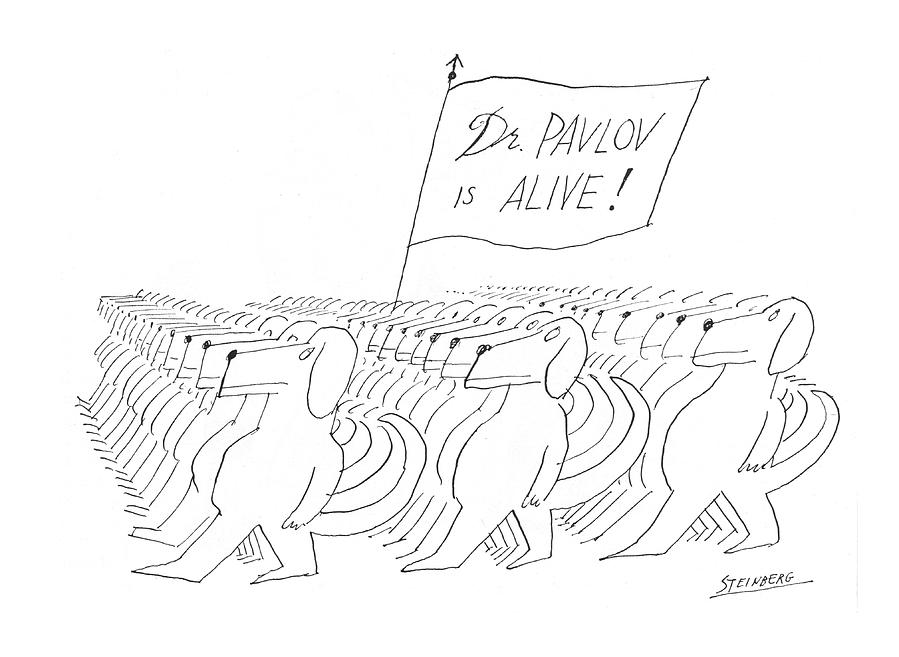
Saul Steinberg in the New Yorker, January 12, 1976

I recently read that dogs—through the imperatives of evolution—have developed expressions that invite positive interactions from their humans like “What a good boy” or a scratch behind the ears whenever, say, Wally looks me in the eye with a kind of urgency. There’s urgency all right, because he’s after something more than just my words or my touch. 
 
The reward that he really wants comes after this hoped-for interaction. It’s a little squirt of oxytocin, a hormone and neuropeptide that strengthens bonding by making me, and then both of us together, feel good about our connection.
 
As you might expect, Wally looks at me a lot when I’m working and I almost always respond. How could anyone refuse that face? Besides, it gives whatever workspace I’m in a positive charge that can linger all day.

Social media has also learned that “likes”—or almost any kind of interaction by other people (or machines) with our pictures and posts—produces similar oxytocin squirts in those who are doing the posting. We’re not just putting something out there; we’re after something that’s both measureable and satisfying in return.

Of course, the caution light flashes when social media users begin to crave bursts of chemical approval like Wally does, or “to feel rejected” when the “likes” aren’t coming fast enough. It’s a feedback loop “of craving to approval” that keeps us coming back for more. Will they like us at least as much, and maybe more than they did the last time I was here?  It’s the draw that always makes us stay on these social media platforms for longer than we want to and always keeps us coming back for more.

Social scientists have been telling us for years that craving approval for our contributions (along with not wanting to miss out) causes social media as well as cell-phone addiction in young people under 25. They are particularly susceptible to its lures because the pre-frontal cortex in their brains, the so-called seat of good judgment, is still developing. Of course, the ability to determine what’s good and bad for you is also underdeveloped in many older people too—I just never thought that included me.

So how I felt when I stopped my daily posting on Instagram three weeks ago came as a definite comeuppance. Until then I thought I had too much “good sense” to allow myself to be manipulated in these ways.

For the past 6 years, I’ve posted a photo on Instagram (or IG) almost every day. I told myself that regular picture-taking would make me look at the world more closely while, at the same time, making me better at capturing what I saw. It would give me a cache of visual memories about where I’d been and what I’d been doing, and posting on IG gave me a chance to share them with others.

In recent years, I’d regularly get around 50 “likes” for each photo along with upbeat comments from strangers in Yemen, Moscow and Beruit as well as from people I actually know. The volume and reach of approval wasn’t great by Rhianna standards, but as much as half of it would always come in the first few minutes after posting every day. I’d generally upload my images before getting out of bed in the morning, so for years now I’ve been starting my days with a series of “feel good” oxytocin bursts.

Of course, you know what happened next. My “cold turkey” from Instagram produced symptoms that felt exactly like withdrawal. It recalled the aftermath of cutting back on carbs a few years back or, after I was in the Coast Guard, nicotine. Noticeable. Physical. In the days that followed, I’d find myself repeatedly gazing over at my phone screen for notifications of likes or comments that were no longer coming. Or even worse, I’d explore identical-looking notifications for me to check other people’s pictures and stories, lures that felt like reminders of the boosts I was no longer getting. I felt “cut off” from something that had seemed both alive and necessary.

It’s one thing to read about social media or cell-phone addiction and accept it’s downsides as a mental exercise, quite another to feel withdrawal symptoms after quitting one of them.

Unlike the Food & Drug Administration, I did’t need anything more than my own clinical trial to tell me about the forces that were at play here, because at the same time that IG owner Mark Zuckerberg is engineering what feels like my addiction to his platform, he is also targeting me with ads for things (that I’m sorry to say) I realized I was wanting much more frequently. That’s because Instagram was learning all along what I was interested in whenever I hovered over one of its ads or followed an enticing link.

In other words, I’d been addicted to soften me up for buying stuff that IG had learned I’m likely to want in a retail exchange that effectively made both IG and Mark Zuckerberg the middleman in every sale. IG’s oxcytocin machine had turned me into a captive audience who’d been intentionally rendered susceptible to buying whatever IG was hawking. 

That seems both manipulative and underhanded to me.

It’s one thing to write about “loss of autonomy” to the on-line tech giants, it is another to have felt a measure of that loss.

So where does this leave me, or any of us?

How do lawmakers and regulators limit (or prevent) subtle but nonetheless real chemical dependency when it’s induced by a tech platform?

Is breaking the ad-based business models that turn so many of us into captive buyers even possible in a market system that has used advertising to stoke sales for more than 200 years? Can our consumer-oriented economy turn its back on what may be the most effective sales model ever invented?

To think that we are grappling with either of these questions today would be an illusion.

The U.S. Federal Trade Commission has just fined Facebook (which is IG’s owner) for failing to implement and enforce narrow privacy policies that it had promised to implement and enforce years ago. The FTC also mandated oversight of Zuckerberg personally. Unlike the CEOs of other public companies, because he has effective ownership control of Facebook, his board of directors can’t really hold his feet to the fire. But neither the fine nor this new oversight mechanism challenge the company’s underlying business model, which is to (1) induce an oxytocin dependency in its users; (2) gather their personal data while they are feeling good by satisfying their cravings; (3) sell their personal data to advertisers; and (4) profit from the ads that are aimed at users who either don’t know or don’t care that they are being seduced in this way.

Recently announced antitrust investigations are also aimed at different problems. The Justice Department, FTC and Congress will be questioning the size of companies like Facebook and their dominance among competitors. One remedy might break Facebook into smaller pieces (like undoing it’s 2012 purchase of Instagram). However, these investigations are not about challenging a business model that induces dependency in its users, eavesdrops on their personal behavior both on-site and off of it, and then turns them into consumers of the products on its shelves. The best that can be hoped for is that some of these dominant platforms may be cut down to size and have some of their anti-competitive practices curtailed.  

Even the data-privacy initiatives that some are proposing are unlikely to change this business model. Their most likely result is that users who want to restrict access to, and use of, their personal information will have to pay for the privilege of utilizing Facebook or Google or migrate to new privacy-protecting platforms that will be coming on-line. I profiled one of them, called Solid, on this page a few weeks back.

Since it looks like we’ll be stuck in this brave new world for awhile, why does it matter that we’re being misused in this way?

Personal behavior has always been influenced by whatever “the Jones” were buying or doing next door (if you were desperate enough to keep up with them). In high school you changed what you were wearing or who you were hanging out with if you wanted to be seen as one of the cool kids.  Realizing that your hero, James Bond, is wearing an Omega watch might make you want to buy one too. But the influence to buy or to imitate that I’m describing here with Instagram feels new, different and more invasive, like we’ve entered the realm of science fiction.

Social media companies like Facebook and Instagram are using psychological power, that we’ve more or less given them, to remove some of the freedom in our choices so that they, in turn, can make Midas kingdoms of money off of us. And perhaps their best trick of all is that you only feel the ache of dependency that kept you in their rabbit holes—and how they conditioned you to respond once you were in them—after you decide to leave.

Saul Steinberg in the New Yorker, November 16, 1968

Maybe the scariest part of this was my knowing better, but acquiescing anyway, for all of those years. 
 
It’s particularly alarming given my belief that autonomy (along with generosity) are the most important qualities that I have.
 
I guess I had to feel what had happened to me in order to understand the subtlety of my addiction, the loss of freedom that my cravings for connection had induced, and my susceptibility to being used, against my will, by strangers for their own, very different purposes.
 
By delivering “warm and fuzzies” every day and getting me to stay for their commercials, Instagram became my small experience of mind control and Big Brother.
 
Over the past few weeks, I see people looking for something in their phones and think differently about what they’re doing. That’s because I still feel some of the need for what they may be looking for too.
 
It gives a whole new meaning to “the dog days” this summer.

+ + +

I’d love to hear from you if you’ve had a similar experience with a social network like Facebook or Instagram. If we don’t end up talking before then, I’ll see you next week.

This post was adapted from my July 28, 2019 newsletter. When you subscribe, a new newsletter/post will be delivered to your inbox every Sunday morning.
Filed Under: *All Posts, Building Your Values into Your Work, Daily Preparation, Using Humor Effectively, Work & Life Rewards Tagged With: addiction and withdrawal, addiction to social media, Big Brother, dog days, facebook, Instagram, manipulation, mind control, oxytocin, prevention, regulation, safeguards, Saul Steinberg, seat of good judgment, social media, social networks

Communities Rise From the Wreckage

July 22, 2019 By David Griesing Leave a Comment

J. M. W. Turner, “Snow Storm – Steam-Boat off a Harbour’s Mouth” (1805)

Some days it’s good to be reminded.
 
I saw the aftermath of a terrible car and motorcycle accident a few days ago, and couldn’t help being caught in its blast radius because its impact reverberated almost to my doorstep.
 
From the epicenter, I heard the wailing of civilian rescuers huddled over what was surely the rider, the motorcycle he’d been on strewn in pieces a few feet away. Several cars had stopped already and knots of onlookers were clustered at the intersection’s nearest corners. 
 
Traffic had backed up for much of the very long block and was throbbing to break through. One neighbor or pedestrian wearing a bright green shirt took to the center of the street, not embodying “Go” but shouting just the opposite: “You’ll have to turn around,” as one car defiantly entered the empty, opposing lane to push through his impatience. “Really,” the Green Man countered, “are you in such a hurry that you’re willing to risk more injuries?”  
 
At their confrontation I thought of going back inside, but feeling his protectiveness too I strained for a look at the aura of assistance that was closer in than this spontaneous traffic monitor who was bravely putting himself between his own safety and more cars that were feinting to get through. 
 
Just then, an equally improvised town crier–perhaps sensing the ambivalence of our sympathies– shouted: “It was an illegal turn, the motorcycle was not at fault” because she too may have been assuming that it was. In the murmuring that followed, it also became clear that the illegal turner had fled the scene, which made the witnesses and passers-by seem to move even closer in, as if to shelter the body that had been left alone in the middle of two city streets.  Surely, it wasn’t just moth-to-flame interest that held us here. I tried to gather my vaguer explanations before another driver tried to power through the threads and associations or the sirens arrived.
 
They ended up converging on what Fred Rogers had said one day to a kid who regularly visited his Neighborhood:

When I was a boy and I would see scary things in the news, my mother would say to me, ‘Look for the helpers. You will always find people who are helping.’

Some years ago I’d been in the middle of a different accident when I hit a dog who’d run into the road and a whirlwind of help, rubbernecking and road rage had spun around me as I cradled that dog in the middle of an even crazier intersection. It added up to one of my worst and best days for many of these same reasons. I can still feel strangers hovering over me, trying to hold back the traffic like a gathering storm, helping.
 
People help because it allows them to draw on their ability to act–that is, to take matters into their own capable hands–before “experts,”  like the police, the ambulance crews, the tow truck drivers who have been on the lookout for wreckage, show up. It’s also acting on the common bond they feel with the fallen, maybe remembering when a stranger had helped them or sensing an as-yet unrealized potential to intervene in the same way themselves.
 
During days like today when selfish and mean can seem front and center, there’s always hope to be found in the helpers. I, for one, never trust that they’ll come, but they still, always seem to. It’s the surprise of grace. And they were there again this week, gathering around a body that had been hit and broken before it was abandoned. 
 
Fortunately, fatefully, these expressions of shared humanity are everywhere when we look for them, from the most extreme circumstances to the most mundane.  Writer Rebecca Solnit described “improvisational communities of help” around earthquakes like the tremor that destroyed much of San Francisco more than a century ago, hurricanes like Katrina that ravaged New Orleans, and the terrorist attack on 9/11 in New York City. A half a year ago, I wrote about a helping community that materialized in a Walmart parking lot after a terrible fire had nearly obliterated a place that could no longer be called Paradise California without shaking your head.
 
In a new article, Yale sociologist and physician Nicholas Christakis has created “a record for analysis” out of the information that still exists about survivors of shipwrecks over a period of 400 years (from 1500 to 1900), drawing tentative conclusions about their post-wreckage collaborations and potentially opening up new ways of assembling “data sources” for testing by social scientists.
 
In today’s post, there is more on Solnit’s observations about human nature and Christakis’ thoughts about cooperative behavior after tragedy.

Tracking on Christakis’ research, the pictures here are of turbulent seas and the inevitable shipwrecks, all by perhaps England’s greatest painter, J.M.W. Turner. Each one invites us to imagine what comes next and to be continuously surprised by how good that can be.

J. M. W. Turner, “Shipwreck Off Hastings” (1825)

 1.            Spontaneous Helping Communities

Rebecca Solnit’s A Paradise Built in Hell: the Extraordinary Communities That Arise in Disaster alerted me to how average people became rescuers during several of the worst catastrophes in American history. She explains it, in part, by how “diving in to help” brings a sense of confidence and liberation that is lacking in people’s private lives. For these civilian rescuers, it’s almost experienced as enjoyment:

…if enjoyment is the right word for that sense of immersion in the moment and solidarity with others caused by the rupture in everyday life, an emotion graver than happiness but deeply positive.  We don’t even have a language for that emotion, in which the wonderful comes wrapped in the terrible, joy in sorrow, courage in fear. We cannot welcome disaster, but we can value the responses, both practical and psychological….The desires and possibilities awakened are so powerful they shine even from wreckage, carnage, and ashes.

It’s as if we can see better versions of ourselves as leaders, problem-solvers, caring adults and members of a flesh-and-blood communities shining through. 
 
Speaking with any assurance “about life today” is always risky, but it does seem that we exalt “minding your own business” as an excuse today for not getting more involved while building as much insulation as we can afford between our private and public lives. It may explain low voter turn-out, general political apathy and cynicism, our involvement with arms-length communities (like Facebook) instead of real ones where we have to get our hands dirty and look our neighbors in the eye, and the time we spend in echo-chambers that reinforce our sense of “us vs. them”  But at exactly the same time that our private lives seem paramount, Solnit’s argument is that we also crave more meaningful engagement than we’ll ever find living behind safety glass. 
 
It is this longing that has a chance to be satisfied when regular people find themselves helping during a car accident or other emergency. We suddenly feel more fully alive than we felt before. Solnit analogizes the fullness that regular people feel under these circumstances to the solidarity and immediacy that soldiers often experience during wartime.

We have, most of us, a deep desire for this democratic public life, for a voice, for membership, for purpose and meaning that cannot be only personal.  We want larger selves and a larger world. It is part of the seduction of war William James warned against—for life during wartime often serves to bring people into this sense of common cause, sacrifice, absorption in something larger.  Chris Hedges inveighed against it too, in his book War Is a Force That Gives Us Meaning: ‘The enduring attraction of war is this: Even with its destruction and carnage it can give us what we long for in life. It can give us purpose, meaning, a reason for living. Only when we are in the midst of conflict does the shallowness and vapidity of our lives become apparent.  Trivia dominates our conversations and increasingly our airwaves.  And war is an enticing elixir.  It gives us resolve, a cause.  It allows us to be noble.’  Which only brings us back to James’s question:  What is the moral equivalent of war—not the equivalent of its carnage, its xenophobias, its savagery—but its urgency, its meaning, its solidarity?

The clutch of men and women kneeling over and attending to the victim sprawled on the intersection near my front door were finding it. 
 
It’s why the Green Man turned himself into a traffic cop right before my eyes. He was finding something that he needed too.

J. M. W. Turner, “Long Ship’s Lighthouse, Lands End” (1834-5)

2.            How Shipwrecked Survivors Came Together Time After Time

In the course of his research about how people behave in social networks, Nicholas Christokis ran an experiment using data he gathered about shipwrecks that took place over the span of four hundred years. He wanted to know how survivors who had “narrowly escaped death and were psychologically traumatized,” often arriving on remote islands “nearly drowned and sometimes naked and wounded” came together (or broke down) as a network of survivors. His findings tended to prove his theory that we carry “innate proclivities to make good societies” even under the most extreme circumstances. 
 
His “Lessons from Shipwrecked Micro-Societies” appeared in the on-line platform Quillette a little over a week ago. Christakis acknowledged many of his experiment’s limitations up front:

The people who traveled on ships were not randomly drawn from the human population; they were often serving in the navy or the marines or were enslaved persons, convicts or traders. Shipboard life involved exacting status divisions and command structures to which these people were accustomed. Survivor groups were therefore made up of people who not only frequently came from a single distinctive cultural background (Dutch, Portuguese, English and so on), but who were also part of the various subcultures associated with long ocean voyages during the epoch of exploration. These shipwreck societies were [also]…mostly male.

Still, given the similarities and differences among these survivor groups in terms of race, gender and hierarchy, it is noteworthy that they rarely devolved into a state of selfishness, brutality or violence in their quest to survive. Instead, they tended to model fairness and cooperation in their interactions, a reduction in previous status divisions, noteworthy demonstrations of leadership and the development of new friendships.

Survivor communities manifested cooperation in diverse ways: sharing food equitably; taking care of injured or sick colleagues; working together to dig wells, bury the dead, co-ordinate a defense, or maintain signal fires; or jointly planning to build a boat or secure rescue. In addition to historical documentation of such egalitarian behaviors, archaeological evidence includes the non-separation of subgroups (for example, officers and enlisted men or passengers and servants) into different dwellings, and the presence of collectively built wells or stone signal-fire platforms. Other indirect evidence is found in the accounts of survivors, such as reports of the crew being persuaded, because of good leadership, to engage in dangerous salvage operations. And we have many hints of friendship and camaraderie in these circumstances.

Christakis is best known for demonstrating how networks of strangers can promote positive behaviors and even altruism through “the contagion” that their influence exerts in the course of their interactions. His new book Blueprint: the Evolutionary Origins of a Good Society makes the additional argument that our genes affect not only our personal behaviors but also provide the drive to join together “to make good societies” whether they are in on-line networks or in the communities where we live and work. The encouraging data from shipwreck communities that Christakis summarized in his article is part of that argument. 
 
In what can seem like a mean-spirited and selfish time, there is hope to be found in the circumstantial evidence that “helping one another” may be hardwired into our genetic programming. 
 
There is hope to be found every time that regular people pitch in to help instead of walking by or refusing to get involved, not because they’re heroic or brave but because they experience something akin to enjoyment and even liberation by doing so.
 
Whenever hope in the future seems to be flagging, look for the helpers. There are several reasons that they’re always around.

This post was adapted from my July 21, 2019 newsletter. When you subscribe, a new newsletter/post will be delivered to your inbox every Sunday morning.


Filed Under: *All Posts, Being Part of Something Bigger than Yourself, Work & Life Rewards Tagged With: community, community building, helping communities, improvised roles, Nicholas Christakis, people helping, Rebecca Solnit, spontaneous helping communities

  • « Previous Page
  • 1
  • …
  • 16
  • 17
  • 18
  • 19
  • 20
  • …
  • 50
  • Next Page »

About David

David Griesing (@worklifeward) writes from Philadelphia.

Read More →

Subscribe to my Newsletter

Join all the others who have new posts, recommendations and links to explore delivered to their inboxes every week. Please subscribe below.

David Griesing Twitter @worklifereward

My Forthcoming Book

WordLifeReward Book

Search this Site

Recent Posts

  • The Desirable Tension Between Moderation & “Enough is Enough” in Our Politics October 11, 2026
  • Cowardice Is Contagious, But So Is Courage September 20, 2026
  • Short Stack of Interesting (dog-days edition) August 19, 2026
  • We Can’t Turn Our Backs on Coming Together July 6, 2026
  • Why Reveal Our Ugliest Truths? April 7, 2026

Follow Me

David Griesing Twitter @worklifereward

Copyright © 2026 David Griesing. All Rights Reserved.

  • Terms of Use
  • Privacy Policy